
Sean de Silva
Well-Known Member
This post is my testimony of the moment when a supposedly happy listener became a zealous investigator. It is the realisation of a gut feeling that my Microline and Shibata styli sounded slightly "harsh" and fatiguing at higher volumes despite an ostensibly good overall performance. It is this epiphany that inspired a dive into the signal chain.
The investigation began with a moment of awareness : While my iFi Zen Phono 3 was always set to 100 pF and defaults to 47K (for MM) from the beginning, the rest of the chain remained a mystery. The Reloop Turn 5 manual doesn't mention tonearm capacitance. What followed was the absolute kicker. The stock interconnects revealed a staggering capacitance of 540 pF/m. I bristled at the DMM. This right here was THE ultimate chokepoint of my vinyl experience. With a total chain capacitance screaming almost 700 pF (tonearm + interconnects + phono stage), resonance was surely being dragged deep into the audible range. This would explain the "harshness" at higher volumes - a subtle fatiguing glare that was never "in-your-face" but certainly not ignorable either.
I turned to the principles commonly espoused by experts to tame fussy MM cartridges - particularly those from Audio Technica:
Capacitance : To push the resonance into the inaudible range, total Capacitance needs to stay between 100-200 pF.
Resistance : If the treble remains peaky at the standard 47K, dropping the resistance can trim or dampen the magnitude of that peak.
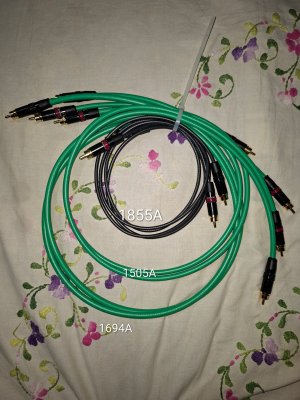
I swapped out the offending 540 pF interconnects for Belden coax 1694A, 1855A and 1505A. All coax interconnects were terminated with Neutrik Rean NYS373. Tests yielded 55 pF/m for 1694A / 1505A and 60 pF/m for 1855A. Tests for turntable + coax capacitance yielded 95 pF for 1694A / 1505A and 105 pF for 1855A. This suggests that the tonearm capacitance is somewhere around 40 pF. The 1694A sounded very good but is too stiff for my liking and difficult to maneuver hence swapped it out for the thinner 1505A which sounded the same as the 1694A. I haven't yet tried the 1855A. I cannot believe that I have actually dialed down from 540 pF to 55 pF !!!
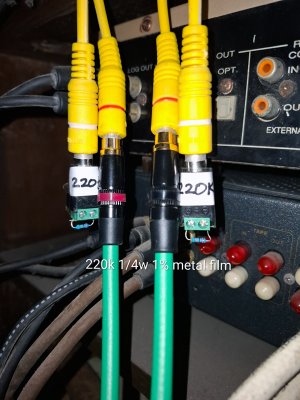
Simultaneously, I used a RCA Y-splitter loaded with 220K 0.25W 1% metal film resistor per channel in parallel with the phono stage 47K. This according to theory should bring the total resistance down to around 38K. Even though it wasn't practically possible to measure this resistance drop (possibly due to interference from the phono stage in-circuit components), I can tell you subjectively that the background is assuredly darker and transients are clean and fast. Instruments now feel more natural. The glare in the top end has vanished. The soundstage has expanded with precise imaging. Bass is tight and authoritative. Mids feel lush. Treble is defined and free of fatigue. Stoked by the chalk and cheese difference, I found myself pulling out a few favourite LPs to enjoy the magical effect of a low capacitance interconnect on a MM cartridge ! On some recordings, the floorstanders seem to disappear in the room and it feels great to behold the music as it was intended to be heard.
The results are the proof of the pudding. By tweaking both the Resistance and Capacitance, I believe that I have unlocked the true potential of the ML and SH diamonds which now breathe freely and sing. These tangible improvements are THE game changer in my vinyl experience.
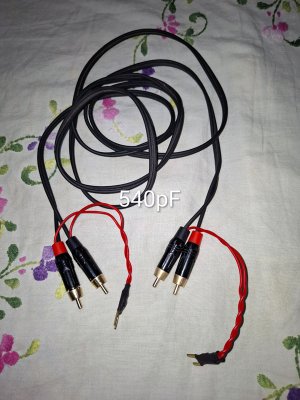
The investigation began with a moment of awareness : While my iFi Zen Phono 3 was always set to 100 pF and defaults to 47K (for MM) from the beginning, the rest of the chain remained a mystery. The Reloop Turn 5 manual doesn't mention tonearm capacitance. What followed was the absolute kicker. The stock interconnects revealed a staggering capacitance of 540 pF/m. I bristled at the DMM. This right here was THE ultimate chokepoint of my vinyl experience. With a total chain capacitance screaming almost 700 pF (tonearm + interconnects + phono stage), resonance was surely being dragged deep into the audible range. This would explain the "harshness" at higher volumes - a subtle fatiguing glare that was never "in-your-face" but certainly not ignorable either.
I turned to the principles commonly espoused by experts to tame fussy MM cartridges - particularly those from Audio Technica:
Capacitance : To push the resonance into the inaudible range, total Capacitance needs to stay between 100-200 pF.
Resistance : If the treble remains peaky at the standard 47K, dropping the resistance can trim or dampen the magnitude of that peak.
I swapped out the offending 540 pF interconnects for Belden coax 1694A, 1855A and 1505A. All coax interconnects were terminated with Neutrik Rean NYS373. Tests yielded 55 pF/m for 1694A / 1505A and 60 pF/m for 1855A. Tests for turntable + coax capacitance yielded 95 pF for 1694A / 1505A and 105 pF for 1855A. This suggests that the tonearm capacitance is somewhere around 40 pF. The 1694A sounded very good but is too stiff for my liking and difficult to maneuver hence swapped it out for the thinner 1505A which sounded the same as the 1694A. I haven't yet tried the 1855A. I cannot believe that I have actually dialed down from 540 pF to 55 pF !!!
Simultaneously, I used a RCA Y-splitter loaded with 220K 0.25W 1% metal film resistor per channel in parallel with the phono stage 47K. This according to theory should bring the total resistance down to around 38K. Even though it wasn't practically possible to measure this resistance drop (possibly due to interference from the phono stage in-circuit components), I can tell you subjectively that the background is assuredly darker and transients are clean and fast. Instruments now feel more natural. The glare in the top end has vanished. The soundstage has expanded with precise imaging. Bass is tight and authoritative. Mids feel lush. Treble is defined and free of fatigue. Stoked by the chalk and cheese difference, I found myself pulling out a few favourite LPs to enjoy the magical effect of a low capacitance interconnect on a MM cartridge ! On some recordings, the floorstanders seem to disappear in the room and it feels great to behold the music as it was intended to be heard.
The results are the proof of the pudding. By tweaking both the Resistance and Capacitance, I believe that I have unlocked the true potential of the ML and SH diamonds which now breathe freely and sing. These tangible improvements are THE game changer in my vinyl experience.


