
Chips vs resistors: Which one makes the best DAC?

Nikhil

Moderator
Staff member
Joined
Dec 8, 2007
Messages
4,619
Points
113
Location
Hyderabad

"... comprehensive comparison of the Gustard X30 and Gustard R30 DACs, and the results are truly shocking for the high-end audiophile world. Many say DACs sound the same because of flat frequency response, but I show why timing accuracy and custom digital filtering are what really matters for creating a deep, 3D soundstage. I compare both the multi-chip X30 and the discrete R2R-based R30, detailing the crucial differences in sound: precision versus richness. Most importantly, I put the Gustard X30 against true flagship competition like the Chord DAVE (with the M-Scaler) and the legendary Schiit Yggdrasil multibit DAC to see if a $3,000 component can genuinely rival the best, most expensive digital sources. The outcome has me seriously considering selling my most valuable gear."


.
 
High praise indeed, specially considering he is comparing a $3000 DAC to a $15000 DAC

I treat these as data points to keep in consideration. Have to hear these first hand.

Having said that - digital is one space where the pace of change is quite hectic. Specially in the area of clock technology which used to be the domain of companies like DCS in the past. This to me has been the most critical area in terms of improved sound quality. Much more than chip architectures, R2R etc.


.
 
@Nikhil i Couldn’t agree more. Getting the timing right is critical in my mind too. I learned about this when @prem and @arj came to visit a couple of years ago.

Voicing and tonality are important as well. This part depends on individual preferences ranging from very clear, dry, well separated presentation of the various elements of music to a warm moist presentation with emphasis on heft/weight and rolled of higher frequencies on the other end of the spectrum.

In my experimentations with various DACs and types I have discovered that I have a preference for a presentation that veers a bit towards the latter.

I however found the (above) reviewers comment that chip based circuits can be tuned (using filters etc) to sound like the popular R2R sound most interesting.

The most mysterious aspect of the character of sound presentation for me still remains the “depth” where it’s possible to discern positions of various instruments/ artists as being closer or farther from the listener position. I guess this is linked with the timing (and probably more complex design and engineering)?
 
The most mysterious aspect of the character of sound presentation for me still remains the “depth” where it’s possible to discern positions of various instruments/ artists as being closer or farther from the listener position. I guess this is linked with the timing (and probably more complex design and engineering)?

Depth , from what I could make out is a combination of resolution as well as speaker placement especially from rear wall. But amp/speaker synergy also seem to matter in getting it right beyond just being resolution although speaker placement is mandatory.
 
@arj thanks for pointing this out. Speaker placement definitely influences the presentation of the sound stage width and depth.
I have observed that once the pulling out of speakers to a point where it sounds right, the challenge of toeing in or toeing out starts.
This is labor intensive with a lot of going back and forth and moving them in small increments
At a certain point of toe in the sound seems to “lock in” but the width and depth may not be as satisfying.
I have found Speakers with a wider cone of dispersion (Tweeters and mid woofers) easier to work with to get a good mix of soundstage width and good localisation of vocals and instruments.
One of the most delightful moments are when the speakers seem to disappear sonically leaving only musical cues hanging in the air - no idea how or why this happens. Grateful for any insights, theories or facts on this phenomenon

The quality of the recordings matter in this regard too, I feel.

Synergy and Sound stage depth are still mysterious elements to me.
I know and recognise them when I hear them but have no clear understanding how they happen.
Beyond the initial power and impedance matching it’s a Happy accident usually 😊

With some set ups I found the sound stage shifts if I move /turn) my head, (not so with my current one, happily). Again no idea why this happens.
Any thoughts, insights on this phenomenon, anyone?

I realise we have veered off the topic of this thread.
 
The most mysterious aspect of the character of sound presentation for me still remains the “depth” where it’s possible to discern positions of various instruments/ artists as being closer or farther from the listener position. I guess this is linked with the timing (and probably more complex design and engineering)?

Depth and instrument position improves dramatically when you use better clocks.
This has been my experience after adding the Ref10 Nano clock to my setup.


.
 
Depth and instrument position improves dramatically when you use better clocks.
This has been my experience after adding the Ref10 Nano clock to my setup.


.
It's not so straightforward. Alongwith the quality of the clock, how close it is to the actual converters matters as well and how well all devices in the digital chain are clock locked matters as well.

Just putting an external high quality clock may or may not improve things depending on the DAC. External clocks are used in studios to ensure that all devices are clock locked and not out of sync due to distances. It is much less an issue in audiophile setups.
 
It's not so straightforward. Alongwith the quality of the clock, how close it is to the actual converters matters as well and how well all devices in the digital chain are clock locked matters as well.

Just putting an external high quality clock may or may not improve things depending on the DAC. External clocks are used in studios to ensure that all devices are clock locked and not out of sync due to distances. It is much less an issue in audiophile setups.
Please correct me if I did not understand your point above….

Apart from the DAC, timing errors can happen with other electronic devices in the chain too? And to prevent this each of them needs a clock and all need to be in sync or locked?
 
Please correct me if I did not understand your point above….

Apart from the DAC, timing errors can happen with other electronic devices in the chain too? And to prevent this each of them needs a clock and all need to be in sync or locked?

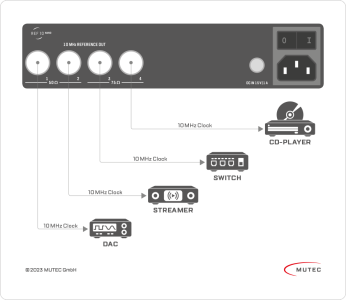
In an audio setup such as what we would use, the following devices can all be synced via a Master Clock

1. Audio Server (which can accept external clocks)
2. Network Switch (which can accept external clocks)
3. DDC / Re-clocker
4. DAC (for DACs that accept external clocks)

In my setup, I have the Mutec working as a Reclocker so effectively acting as a source.
When properly synced via a Master Clock, digital can and does sound fabulous.


.
 
It's not so straightforward. Alongwith the quality of the clock, how close it is to the actual converters matters as well and how well all devices in the digital chain are clock locked matters as well.

Just putting an external high quality clock may or may not improve things depending on the DAC.

True. As with anything else in audio everything matters.
The point I am making is that clocking is critical to good digital.

With each step that you take in improving the synchronization of your devices there are gains to be made.

.
 
In an audio setup such as what we would use, the following devices can all be synced via a Master Clock

1. Audio Server (which can accept external clocks)
2. Network Switch (which can accept external clocks)
3. DDC / Re-clocker
4. DAC (for DACs that accept external clocks)

In my setup, I have the Mutec working as a Reclocker so effectively acting as a source.
When properly synced via a Master Clock, digital can and does sound fabulous.


.
I never knew the network switch needed a external clock. From some reading,
  • Ethernet is packet-based and asynchronous. Timing is reconstructed at each hop.
  • The DAC has no idea when those packets were sent; it only cares about when it reads them from its own buffer.
Any perceived change from clocking the switch would come from EMI/PSU noise behavior, not from timing precision.
So connecting the network switch to the master clock is really about reducing correlated noise and phase noise coupling — not about data timing accuracy per se.

That is what I got to read.. Any thoughts?

While using a traditional cd transport and dac, the system runs synchronous and hence the master clock really helped by ensuring both devices operate in exact temporal lockstep — eliminating the need for the DAC to reconstruct a noisy embedded clock and reducing conversion jitter.

I have very less experience in using these things in a system (pc playback or streaming) where the transport/DAC interface is asynchronous (USB, Ethernet, etc.)

While using a Mutec device I however noticed greater focus in a digital file playback (non cd) situation though.
 
Last edited:
I never knew the network switch needed a external clock. From some reading,
  • Ethernet is packet-based and asynchronous. Timing is reconstructed at each hop.
  • The DAC has no idea when those packets were sent; it only cares about when it reads them from its own buffer.
Any perceived change from clocking the switch would come from EMI/PSU noise behavior, not from timing precision.
So connecting the network switch to the master clock is really about reducing correlated noise and phase noise coupling — not about data timing accuracy per se.

That is what I got to read.. Any thoughts?

While using a traditional cd transport and dac, the system runs synchronous and hence the master clock really helped by ensuring both devices operate in exact temporal lockstep — eliminating the need for the DAC to reconstruct a noisy embedded clock and reducing conversion jitter.

I have very less experience in using these things in a system (pc playback or streaming) where the transport/DAC interface is asynchronous (USB, Ethernet, etc.)

While using a Mutec device I however noticed greater focus in a digital file playback (non cd) situation though.
“…Any perceived change from clocking the switch would come from EMI/PSU noise behavior, not from timing precision.”???
It’s all in the same signal path?
This is getting too complicated for me.
 
Last edited:
Any perceived change from clocking the switch would come from EMI/PSU noise behavior, not from timing precision.
So connecting the network switch to the master clock is really about reducing correlated noise and phase noise coupling — not about data timing accuracy per se.

I've noticed an improvement in sound when changing to a Linear Power Supply on a network switch. I have shared on another thread that in my setup it cleared up the sound at the top of notes. Perhaps this was related to the frequency riding on the SMPS used before on the same switch. I noticed another improvement when I changed to a Silent Angel Bonn network switch which offered among other things a better clock. The sound improved in terms of more texture and clarity in the lower frequencies. I haven't yet done the network switch clock sync with the master clock.

Just sharing whatever I have noticed in my setup for what it's worth.

  • Ethernet is packet-based and asynchronous. Timing is reconstructed at each hop.
  • The DAC has no idea when those packets were sent; it only cares about when it reads them from its own buffer.

From what I know there are two separate things going on here ... first is the logical construct of the "data packets" which operate at the transport layer of the network structure. But down at the wire you are still dealing with (relative) voltages. These are susceptible to power supply (as mentioned earlier) and the other is the on board clock signal "edge" (the square wave that determines the discrete levels of the 1s and 0s). This is my very rudimentary understanding of things so please don't take my words as any authority on this. Only too happy to be corrected.

In terms of implementation, using a DDC or Reclocker offers noticeable gains in sound and is a very easy first step in improving your digital. Adding a Master Clock to start synchronizing your other devices needs a bit more care. Ideally using a solution from a single supplier would be recommended i.e. a DCS or an SMSL stack. I've taken the Mutec route including digital cables. I've kept DAC, Network Switch and Audio Server sync for some time down the road.


.
 
“…Any perceived change from clocking the switch would come from EMI/PSU noise behavior, not from timing precision.”???
It’s all in the same signal path?
This is getting too complicated for me.
1. EMI-related:
When you sync a network switch to a really clean master clock, you can slightly reduce the tiny high-frequency noise (EMI) that its internal circuits and Ethernet ports create. That cleaner clock can mean less electrical “hash” riding along the cables or leaking through the ground, which might make life a bit easier for the sensitive analog parts of your DAC.

2. PSU-related:
Changing how the switch is clocked can also shift the way its power supply behaves — things like switching noise or tiny ripples in current draw. If that noise happens to travel through shared power or ground connections, it could subtly affect the overall noise floor of your audio system. It’s not about better timing of the bits, but about keeping the electrical environment a little quieter.

Bottom line

When you clock a network switch in an audiophile system:
  • You are not synchronizing timing relevant to audio playback.
  • You might be altering the analog noise environment (through reduced EMI or different PSU behavior).
  • Any audible effect — if real — comes from that noise coupling, not from the switch’s packet timing.
 
In terms of implementation, using a DDC or Reclocker offers noticeable gains in sound and is a very easy first step in improving your digital.
I've taken the Mutec route including digital cables. I've kept DAC, Network Switch and Audio Server sync for some time down the road.
@Nikhil , I have tried the Mutec MC-3+ USB in my system many years ago, although I did not dig any deeper into the technology. In your case are you treating the Mutec as a "DDC" and its re clocking ( 1G tech ) as the "masterclock". Or have you added another reclocker too into the chain ? If I undetstand your setup now, you have a good "network switch" -> "mutec" -> "dac". What output from the mutec do you use ?

I see a Ref 10 in your system description.
1772023154993.png
If you are using the ref 10, Are you connected like this ? Switch, streamer, dac running on the master clock ? If so, what is the relevance of the clock in the MC-3 ?
 
Last edited:
If you are using the ref 10, Are you connected like this ? Switch, streamer, dac running on the master clock ? If so, what is the relevance of the clock in the MC-3 ?

The Mutec MC-3+ USB functions as an all in one reclocker, clock distributor, format converter and master clock. It is best used to convert USB to AES/EBU, SPDIF, Optical etc. It excels as a single box solution to clean up a noisy computer server signal. When used all by itself it did bring noticeable gains to my digital. I consider it the most significant addition to my setup.

My setup was Switch > Audio Server > Mutec MC3+ USB > DAC
Mutec to DAC is via optical. To me optical sounds better than digital cable (SPDIF).
The best sounding is supposed to be AES/EBU but my DAC does not have it.

Last year I added the REF 10 Nano master clock which offers a better quality 10 MHz reference clock than the inbuilt clock of the MC3+ USB. Addition of the Ref10 Nano was not the big jump I expected it to be but this was when I was using Spotify. When I switched to Qobuz and Tidal the difference was very noticeable - it did exactly as it says on the box - "Including the REF10 NANO in your system results in higher transparency, more clearly defined bass, darker background, better instrument staging and extended imaging."

In my setup I am using the Ref10 Nano solely as master clock for the MC3+ USB. Further gains are there to be had when used to clock the switch and audio server as well. Have kept that for experimenting at a later date.


.
 
The Mutec MC-3+ USB functions as an all in one reclocker, clock distributor, format converter and master clock. It is best used to convert USB to AES/EBU, SPDIF, Optical etc. It excels as a single box solution to clean up a noisy computer server signal. When used all by itself it did bring noticeable gains to my digital. I consider it the most significant addition to my setup.

My setup was Switch > Audio Server > Mutec MC3+ USB > DAC
Mutec to DAC is via optical. To me optical sounds better than digital cable (SPDIF).
The best sounding is supposed to be AES/EBU but my DAC does not have it.

Last year I added the REF 10 Nano master clock which offers a better quality 10 MHz reference clock than the inbuilt clock of the MC3+ USB. Addition of the Ref10 Nano was not the big jump I expected it to be but this was when I was using Spotify. When I switched to Qobuz and Tidal the difference was very noticeable - it did exactly as it says on the box - "Including the REF10 NANO in your system results in higher transparency, more clearly defined bass, darker background, better instrument staging and extended imaging."

In my setup I am using the Ref10 Nano solely as master clock for the MC3+ USB. Further gains are there to be had when used to clock the switch and audio server as well. Have kept that for experimenting at a later date.


.
Gotcha. So your setup is like this now ? ISP provider router -> Switch -> Streamer (audio server) via USB -> Mutec (Mutec uses external clock - Ref 10) -> Mutec Optical out to DAC.

From what I know so far, SPDIF and AES/EBU are essentially the same but AES/EBU is built for long runs of cables in high EMI environments. So in a home system, why don't you just try SPDIF itself ? In some cases, some DACs have better AES input stages. That is probably why many listeners find AES to be better on some dacs. If your dac has a great SPDIF input stage, you should try it.
 
Last edited:
Wharfedale Linton Heritage Speakers in Red Mahogany finish at a Special Offer Price. BUY now before the price increase.
Back
Top