Are you happy with your phono stage?

Are you happy with your phono stage?

  • Happy

    Votes: 16 84.2%
  • Unhappy

    Votes: 3 15.8%
  • Neither happy nor unhappy

    Votes: 2 10.5%
  • I know someone else who is happy

    Votes: 1 5.3%
  • I know someone else who is unhappy

    Votes: 1 5.3%
  • I don't know what a phono stage is

    Votes: 1 5.3%

  • Total voters
    19
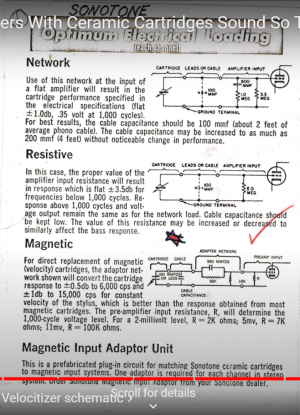
I have tried many turntables (MM and ceramic) to date with several different integrated amplifiers but was always unhappy because each cartridge has its own loading and impedance that is not matched by most phono preamps. That is exactly why you require a customizable phono preamp like the IFi iPhono but my poor ass cannot afford it. Moreover I have always thought that ceramic cartridges sounded as good as MM but couldn't find any good ceramic preamps. So I found myself a very cheap DIY passive filter EQ circuit, basically a velocitizer circuit that connects ceramic turntables (no preamp) to any decent MM phono inputs and this works excellent with the generic Philips ceramic cartridge 15GP224 and is even better than all other equipment that I have heard till date. I use the third diagram in this vintage article and its mentioned there that its response is better than most MM cartridges.
Cartridge.png
 
I have tried many turntables (MM and ceramic) to date with several different integrated amplifiers but was always unhappy because each cartridge has its own loading and impedance that is not matched by most phono preamps. That is exactly why you require a customizable phono preamp like the IFi iPhono but my poor ass cannot afford it. Moreover I have always thought that ceramic cartridges sounded as good as MM but couldn't find any good ceramic preamps. So I found myself a very cheap DIY passive filter EQ circuit, basically a velocitizer circuit that connects ceramic turntables (no preamp) to any decent MM phono inputs and this works excellent with the generic Philips ceramic cartridge 15GP224 and is even better than all other equipment that I have heard till date. I use the third diagram in this vintage article and its mentioned there that its response is better than most MM cartridges.
View attachment 91818

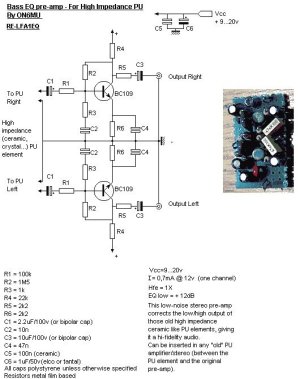
this is the version which I had built and used for years, pretty good

Ceramic Cartridge Phono Stage.jpg
 
Bought audio technica AT LP 70X turntable for my denon pma900hne which has built in phono stage. Found something missing sound wise. Tried with project phono preamp, sound improved. Still wanted some further improvement in sound quality, so bought a low budget fosi audio box x2 tube phono preamp. Sound was surprisingly good. So now stuck with it now for the moment. Speakers are Dali Oberon 5.
Hi just wanted to enquire , there are reports of the lp70x having skipping issues, did you face any with your unit.

Regards,
 
Using the Denon DP 400 with ortofon red cartridge. Matches well with the Denon pma 700hne phono stage. No need of any phono preamp. Since already in the rabbit hole, planning to upgrade to ortofon blue cartridge in near future.
 
Yes, has a detachable headshell. Can try different cartridges unlike lp70x, wherein you can change stylus only. But not recommended for more expensive audio tecnica stylus. Also Denon dp 400 being a mid entry level turntable, it’s recommended to go in for ortofon blue cartridge max.
 
Can try to solve your skipping problem with lp70x by putting slight weight on the factory fitted head of the tone arm to increase the tracking force. Very very light weight. Can give a try. Other possibilities are stylus must not be exactly in the centre. Can remove the stylus and refit. Since might not have been fitted correctly. Can see the YouTube video, how to change the stylus.
 
Can try to solve your skipping problem with lp70x by putting slight weight on the factory fitted head of the tone arm to increase the tracking force. Very very light weight. Can give a try. Other possibilities are stylus must not be exactly in the centre. Can remove the stylus and refit. Since might not have been fitted correctly. Can see the YouTube video, how to change the stylus.
Ya was seeing that happen in the Audio Technica model , also the lack of counter weight can make it prone to skipping .
 
this is the version which I had built and used for years, pretty good

View attachment 91847
Reubensm. Good morning. I have a Sonotone 9 TA which came with my Lenco. Since it is over 60 y old what are the chances of it being functional ( the dual tip stylus is new/ unused). On my old ceramic compatible amp it sounded excellent. What would be the cost of a reasonable ceramic phono stage as I do have a few ceramic carts ie Philips GP 224/204, 215, EEI mono and a Ronette. Thanks
 
Reubensm. Good morning. I have a Sonotone 9 TA which came with my Lenco. Since it is over 60 y old what are the chances of it being functional ( the dual tip stylus is new/ unused). On my old ceramic compatible amp it sounded excellent. What would be the cost of a reasonable ceramic phono stage as I do have a few ceramic carts ie Philips GP 224/204, 215, EEI mono and a Ronette. Thanks
Good morning sir, really good Ceramic cartridges like those from Sonotone, are part of folklore these days as most of the available ones are Chinese. Sonotone and Philips (Holland) made some of the best every ceramic cartridges and with the right phonostage, they were capable of sounding very good.

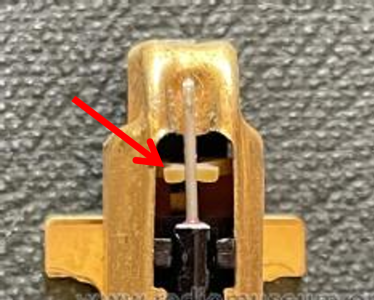
They usually seem to last forever, however cartridge functionality is fully dependent on the condition of the stylus yolk. The stylus yoke is the pivoting carrier or coupling bar that transfers the stylus’s motion into the cartridge’s internal ceramic transducing element. In Sonotone ceramic cartridges, the yoke is typically made of a rubber‑composite and sits directly behind the stylus shank. It physically links the stylus to the ceramic bimorph element, allowing groove motion to be converted into around 400 millivolts which goes straight to your amp's input (the arrow points to the stylus yolk in the picture below):

Sonotone 9TA.png

Even if you dont have a stylus fitted, an easy way to check if a ceramic cartridge works (assuming it is mounted and wired) is to use a tiny screwdriver tip and gentle tap the stylus yolk. Your tap should result in tapping sounds on both channels (if using a stereo cart). If the stylus yolk is not in good shape, it effects performance - either low output, distorted sound or tracking issues. If the yolk is missing, the cartridge is done.

The stylus yolk is a common fixture on ceramic cartridges and is perhaps its most important part.

On the topic of ceramic phonostages, the only way perhaps to find them is on older amplifiers or to build one. I am not aware of any that are in commercial production these days.

Regards.
 
Last edited:
Wharfedale Linton Heritage Speakers in Red Mahogany finish at a Special Offer Price. BUY now before the price increase.
Back
Top