
It’s a stretch to assume that this ridiculous experiment hurts audiophiles?Audiophiles "hurt" over findings that say they spent tooooo much? Shocker!

You are using an out of date browser. It may not display this or other websites correctly.
You should upgrade or use an alternative browser.
You should upgrade or use an alternative browser.
Audio signals sent through copper wire, a banana, or wet mud
- Thread starter Analogous
- Start date
dafreaking
Active Member
did you see the "hurt" in " or choose to completely ignore that like wet mud
If You want it to be so, it willdid you see the "hurt" in " or choose to completely ignore that like wet mud
square_wave
Well-Known Member
This is quite true. I remember a decade ago having a conversation with a group of "double blind testers" on an audio forum. I tried to tell them that beyond the point where basic mesurements and technical parameters are reliably met, the differences are minor but some of those minor differences are huge differences for some people depending upon their unique context in terms of equipment they own and what they are looking for. So, I suggested an alternative testing method:When the test itself is rigged to align with an opinion, it is neither an experiment nor a finding.
The equipment are kept in a different room or kept covered. Do this with an experienced listener who is intimately aware of the system and listening environment where the test is being done. Just the loudspeakers are visible. Now you swap gear or cables without the listener knowing any of it. Let the listener who owns the system listen to however long they want. Redo / Swap as many times as possible while keeping the listener blind to what gear / cable is being used. Do volume matching/swaping using some method that does not affect the signal in anyway. As long as the expereinced listener is able to identify his preference reliably, the test should be valid. This type of a test resembles typical real world scenarios for an audiophile.
The "double blind tester" group will have none of it! They need to do it their way which will get them the results they want.
Many blind tests are:
- Quick A/B switches
- Done in unfamilier systems and environments
- Conducted over seconds using some random music.
- Many participants are not "trained listeners"
- Real differences show up over long-term listening ( Many people look for unique strengths and weaknesses in the gear / cable )
- Fatigue, tone density, spatial cues, and emotional engagement emerge over hours or days
- Rapid switching forces analytical listening instead of musical immersion
- Very resolving systems reveal micro-dynamics and decay differences. Average blind tests use modest gear in unfamiliar rooms
- The room + familiarity matter enormously
- Blind tests rarely happen in optimized, owner-familiar environments.
I am surprised, looking back at this discussion on how much time I have spent discussing this experiment and its findings (flawed or not)
Maybe @dafreaking is right. It has caused a tremor in the very foundation of my audio convictions
Maybe @dafreaking is right. It has caused a tremor in the very foundation of my audio convictions

Why waste time talking of this. Those who believe the test can use banana cables and those who feel there is a difference can go bananas over cables
There are enough tests where famous wine lovers are unable to tell differences between cheap and expensive wines or experts even preferring instant coffee over "superior" beans
Its a useless debate unless one listens actually to a system blindfolded.
There are enough tests where famous wine lovers are unable to tell differences between cheap and expensive wines or experts even preferring instant coffee over "superior" beans
Its a useless debate unless one listens actually to a system blindfolded.
square_wave
Well-Known Member
It does not have to. You know if something works for you after listening to it for about a day or a week max. If it does not, you will know that too. Easy!It has caused a tremor in the very foundation of my audio convictions
Remember, loudspeakers are the only gear that can produce big enough distortions these days. All other devices have reached a point, where measurable distortions have reached a threshold that is miniscule. So it is only the ART aspect of the design that will help you get what you need in your system. Audiophilia is all about the emotional connection so dont get caught up in all these stuff..IMHO.

grindstone
Well-Known Member
It's good, IMO, that these things periodically come-up. Part of the trip, at least for those of us with strong interests. All the "audibility of..." sorts of corners can eat some time and, for me at least, they help us decide what we're spending time on. With time and age, most of us refine the process of closing our minds (and it's the right call for us) 
One of the greatest things about this group is that it has a wisdom to not take itself crazy-audiophile-over-seriously. People remain civil in discourse and open to experience -- and to others having different experiences. I can't even tell you how valuable that is to me and how rare in my (virtual audio) travels. I don't know how much if any of that is cultural and/or how much is masterful self-discipline. I am simply grateful to have found this place and you people. What I can promise you is that, if distortion were mentioned 35 years ago on Usenet, that would've generated 30 responses regarding any applicability of same to Any subject
It is a useful topic and it was good to raise it. Say that instead you had raised a paper on audibility of group delay or the GedLee metric or impact of VHF freqs or some other, "less-charged" but related topic. You look at any of these things (and now you've read Toole etc) and it reminds one of the statistical characterizations of humans.
I didn't do this test, in particular, so I can't comment, but I've done them in the past a couple times. If I were full of coffee and had spare media, I'd make copies and send them around and turn it into an excuse to make an audio get-together with a couple local friends. There are things, both ways, that I'll never be able to explain. I think these topics help all of us on our audio paths to decide what is of interest. We both grow and better-inform our own directions. A lot of things come-around every 15 years. They're fun, sometimes
One of the greatest things about this group is that it has a wisdom to not take itself crazy-audiophile-over-seriously. People remain civil in discourse and open to experience -- and to others having different experiences. I can't even tell you how valuable that is to me and how rare in my (virtual audio) travels. I don't know how much if any of that is cultural and/or how much is masterful self-discipline. I am simply grateful to have found this place and you people. What I can promise you is that, if distortion were mentioned 35 years ago on Usenet, that would've generated 30 responses regarding any applicability of same to Any subject
It is a useful topic and it was good to raise it. Say that instead you had raised a paper on audibility of group delay or the GedLee metric or impact of VHF freqs or some other, "less-charged" but related topic. You look at any of these things (and now you've read Toole etc) and it reminds one of the statistical characterizations of humans.
I didn't do this test, in particular, so I can't comment, but I've done them in the past a couple times. If I were full of coffee and had spare media, I'd make copies and send them around and turn it into an excuse to make an audio get-together with a couple local friends. There are things, both ways, that I'll never be able to explain. I think these topics help all of us on our audio paths to decide what is of interest. We both grow and better-inform our own directions. A lot of things come-around every 15 years. They're fun, sometimes
Last edited:
Nicely expressed @grindstone !It's good, IMO, that these things periodically come-up. Part of the trip, at least for those of us with strong interests. All the "audibility of..." sorts of corners can eat some time and, for me at least, they help us decide what we're spending time on. With time and age, most of us refine the process of closing our minds (and it's the right call for us)
One of the greatest things about this group is that it has a wisdom to not take itself crazy-audiophile-over-seriously. People remain civil in discourse and open to experience -- and to others having different experiences. I can't even tell you how valuable that is to me and how rare in my (virtual audio) travels. I don't know how much if any of that is cultural and/or how much is masterful self-discipline. I am simply grateful to have found this place and you people. What I can promise you is that, if distortion were mentioned 35 years ago on Usenet, that would've generated 30 responses regarding any applicability of same to Any subject
It is a useful topic and it was good to raise it. Say that instead you had raised a paper on audibility of group delay or the GedLee metric or impact of VHF freqs or some other, "less-charged" but related topic. You look at any of these things (and now you've read Toole etc) and it reminds one of the statistical characterizations of humans.
I didn't do this test, in particular, so I can't comment, but I've done them in the past a couple times. If I were full of coffee and had spare media, I'd make copies and send them around and turn it into an excuse to make an audio get-together with a couple local friends. There are things, both ways, that I'll never be able to explain. I think these topics help all of us on our audio paths to decide what is of interest. We both grow and better-inform our own directions. A lot of things come-around every 15 years. They're fun, sometimes
This is indeed a social media forum devoted to discussions on the fascinating aspects (to us) of the Audio and the Visual.
Social media was and is intended to help us share opinions, share knowledge, ask questions, find answers and debate these.
As you have pointed out in most Social media platforms discussions sometimes become uncivil, unpleasant and toxic even.
We all need to constantly watch how we express our opinions and emotions- the language, tone etc.
Bans on social media use and access by children and teenagers is happening in many countries as the evidence of its negative impact is very evident. But they will become adults soon…
What is less studied if the effects of social media use in adults. We are left to navigate this on our own.
Hopefully we will get better with age
I did find this review:
grindstone
Well-Known Member
You were just ahead of the curve; now some Chinese cats are thrashing it up
 www.diyaudio.com
New member from China: Discussing the Wire/Banana/Mud Experiment
Hello diyAudio community, My name isnigel and I’m an audio enthusiast from China. I recently created a video analysis of Pano’s famous “Wire vs. Banana vs. Mud” blind test for the Chinese audience (link...
grindstone
Well-Known Member

Exotic Speaker Driver Materials Fail to Beat Cheap Drivers in Blind Tests, According to Engineers
Most 'beryllium' drivers aren't even pure beryllium, and engineers say it wouldn't matter if they were.
 www.headphonesty.com
I tell you we are all wasting our time and money..all we need are cheap mp3 players connected to cheap driver via cheap amps using bananas and Mud.
The Key is to listen Blind.
Every experiment can only speak within the boundaries and limitations of what it measures/ finds in the context of the method used. Nothing more.Exotic Speaker Driver Materials Fail to Beat Cheap Drivers in Blind Tests, According to Engineers
Most 'beryllium' drivers aren't even pure beryllium, and engineers say it wouldn't matter if they were.
I tell you we are all wasting our time and money..all we need are cheap mp3 players connected to cheap driver via cheap amps using bananas and Mud.
The Key is to listen
We may or may not like the findings. But hey are nevertheless the findings of this particular experiment.
We can of course replicate it and see if these are true or not.
Or critique the methodology in relation to the conclusions reached by the authors, if we can come up with alternative ones.
In this case I think the Headline used by Headpjonesty is misleading. It conflates personal views of a speaker designer, a founder of ASR and a small study done by a German Techincal university (it’s linked but is in German)
On the experiment the article says: “The methodology was straightforward. Take six tweeters made of different materials. Equalize their frequency response and phase using digital filters, within ±1 dB from 2 kHz to 22 kHz. Put ten listeners in an anechoic chamber and ask if they can tell the tweeters apart.
After all that careful matching and filtering, they couldn’t tell them apart.“
That’s the finding whether we like it or not. The rest is made up of opinions.
This is very far removed from our real life experience of audio in our homes (comparing drivers, anechoeic chambers, frequency matching etc)
The cobra effect comes to mind:
Last edited:
Even though this shows that no ears are perfect - not a single person is going to replace all their cables with either mud or bananas & everyone is going to sleep at night with their beliefs reinforced.
I see both pros & cons with this methodology of experiments.
Biggest CON is that you are not a part of this test so these are still not your ears and it is still just a subjective opinion like all else.
The biggest PRO I see is this experiment suggests that if you are just starting out in the hobby or have a limited budget - you can see that the cables have a very minuscule or negligible effect on the entire chain compared to the effects of lets say a speaker or sufficient amplification, so that is where you want to put more of your money. The Novelties like cables, isolation feet, frequency absorbing crystals and off-grid transformers can come later.
Also - eventually everyone makes their set of beliefs - even though we may know something is just placebo - we tend to convince ourselves about their merits. In the end - the brain has to be convinced and you will have the best system in the world.
Sticking to the cables - I have a mix of cables - amazon cables, audiophile cables, diy cables, studio cables, boutique cables, heavy duty physics jargon & lab sweat infused cables. On a good day - I can't tell which system has which cables - cause I am very good at cable management
I see both pros & cons with this methodology of experiments.
Biggest CON is that you are not a part of this test so these are still not your ears and it is still just a subjective opinion like all else.
The biggest PRO I see is this experiment suggests that if you are just starting out in the hobby or have a limited budget - you can see that the cables have a very minuscule or negligible effect on the entire chain compared to the effects of lets say a speaker or sufficient amplification, so that is where you want to put more of your money. The Novelties like cables, isolation feet, frequency absorbing crystals and off-grid transformers can come later.
Also - eventually everyone makes their set of beliefs - even though we may know something is just placebo - we tend to convince ourselves about their merits. In the end - the brain has to be convinced and you will have the best system in the world.
Sticking to the cables - I have a mix of cables - amazon cables, audiophile cables, diy cables, studio cables, boutique cables, heavy duty physics jargon & lab sweat infused cables. On a good day - I can't tell which system has which cables - cause I am very good at cable management
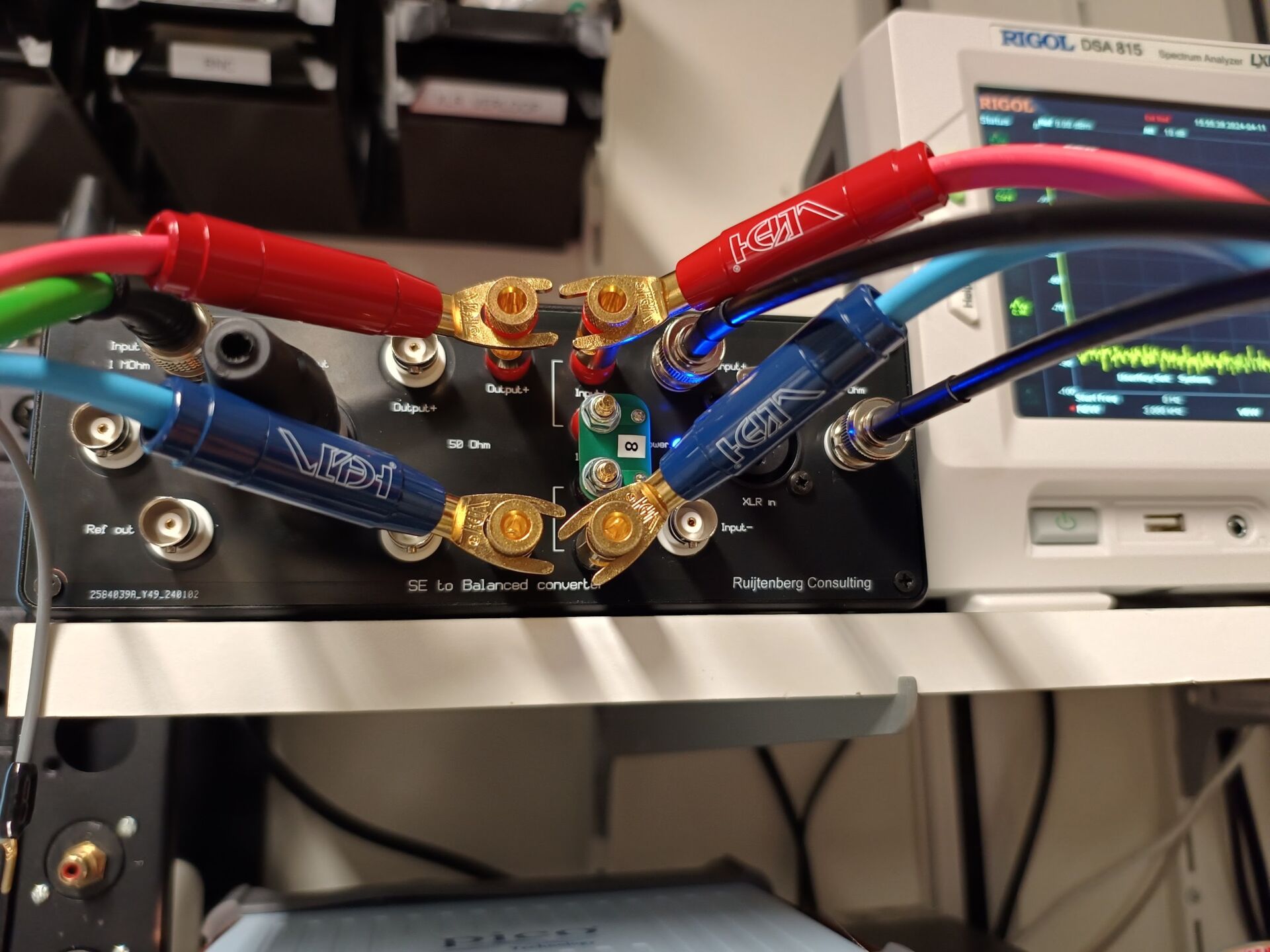
Someone got down to measuring cables
 www.alpha-audio.net
Megatest speaker cables – 32 cables listened to and measured!
Following the mega interlink test, we also measured and listened to 32 speaker cables. This to determine whether certain elements we hear are also measurable. T
www.alpha-audio.net
We also did some – electrical! – response measurements on a real speaker. This is much more interesting than on a dummy, since all speaker cables measure perfectly on a dummy, because it is non-inductive and has a dead straight response by itself. A speaker in the real world is not like that. In short: it is much more interesting to use a real speaker.
Also, the speaker forms a circuit with the amplifier – in this case a Bryston PowerPac 300 (damping factor of 500 at 20 Hz) and that makes that there is interaction between the two. How an amplifier reacts to a speaker has to do with, among other things, the damping factor of the amplifier and the impedance variations of the speaker. Remember, however, that the speaker cable is part of this circuit. So we are measuring the entire circuit in this setup.
Wharfedale Linton Heritage Speakers in Red Mahogany finish at a Special Offer Price. BUY now before the price increase.
Similar threads

- Replies
- 17
- Views
- 11K


- Replies
- 0
- Views
- 10K
- Replies
- 29
- Views
- 25K