Any good references for calculation of Speaker & Amplifier current / Voltage / Power matching ?

The confusion often arises when people mistakenly connect impedance to loudness, which is incorrect.
A 100 dB speaker requires significantly less power than an 89 dB speaker to achieve the same sound pressure level (SPL).
Impedance is only relevant in terms of whether your amplifier can safely provide the necessary watts. This leads to misunderstandings. In certain configurations, lower impedance can make the amplifier work harder, causing some to think, "It's quieter, so I need to increase the volume." However, the actual limitation is the amplifier's current capacity, not the impedance itself. Therefore, the simplified and accurate conclusion is: Impedance influences the amplifier load, not the loudness of the speaker. Sensitivity determines loudness, not the stress on the amplifier.
 
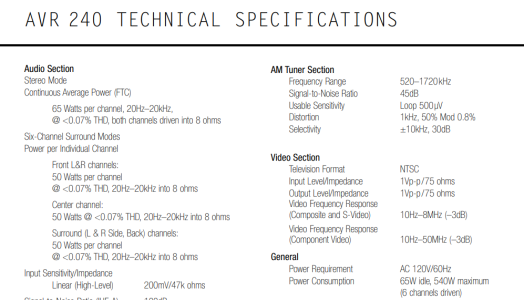
Just ignore there tall claims, majority of AVRs can hardly support even a 4 Ohms load. Even there 6/ 8 Ohms support is only partially true for "both ch. driven" and "not all ch. driven" at full power bandwidth. Such high current figures are achievable only in there lab (read- dreams) conditions. Your AVR may go into protection mode during impedance dips of any such low sensitivity, demanding power hungry speakers. Its always safe to stick to there supplied speakers only. Very few companies (like Benchmark ) can support high current , as claimed in specs. Output devices can hardly supply 3 to 4A for a very short duration at there rated operating voltage.
This parasound is given as 45 amperes.


Current Capacity
45 amps peak, per channel

Slew Rate
> 130 volts per microsecond

 
Last edited:
Current Capacity
45 amps peak, per channel

Their highest power is claimed 600W bridged into 8 ohms, lets apply Power=I2R equation.
So, I2x8=600, we get I=8.6Amps RMS, convert to peak ie 8.6x1.414, we get 12.2Amps. That 45Amps is their marketing's imagination.

Actually audio marketing has no limits, totally snake oil, they write whatever they want to. We know how much hot a 25W soldering iron gets, its so hot that it can seriously burn us. Do you think a 1 inch coil can handle that much of heat, so I leave it to others to figure out how much RMS power a 1 inch coil can handle. I know iron is continuous 25W and speaker/amp is not, but even then there has to be some limits.

If you have speaker rated at X watts then use an amplifier slightly higher power than that for headroom and clipping reason. And ensure the amp can handle the load impedance, there is no proper way of matching given these tall marketing claims. And to confuse even further people claim X amp works better with Y speakers again, no scientific basis, purely subjective.
 
@diyaudio Actually when the need is for high current like that, typically the impedance of the speaker will drop to 1-2 ohms and won't stay at 8 ohms. So a static calculation like that helps no one. In such a case the current delivered might go well above the 12A in static case. However it depends on the power supply of the amp. Can't say whether that 600W number is also imagination.

Computing these things from paper specs is useless. All these need to be measured with a real dynamic load like a demanding speaker. One can never decide whether a particular amp works with a particular speaker just by paper specs. It is an utterly fruitless exercise.
 
Actually when the need is for high current like that, typically the impedance of the speaker will drop to 1-2 ohms and won't stay at 8 ohms.
Pls answer below
1) Where did you get that drop of 1-2 ohms?
2) How can impedance go below Re of coil, lets say Re is 3.5 ohms then how is 1-2 ohm is possible, impedance has capacitive/inductive component over and above of Re, right?
3) Pls show impedance curve of any driver dropping to 1-2ohms?
 
Computing these things from paper specs is useless. All these need to be measured with a real dynamic load like a demanding speaker. One can never decide whether a particular amp works with a particular speaker just by paper specs. It is an utterly fruitless exercise.
If the manufacturer gave detailed real specs then it becomes very easy but audio is full of fake figures. But we need to start somewhere and trial and error approach is sub optimal at best.

Amps (both older class A/B and newer class D) are very old and mature technology and a speaker is not a problem for the amp, fake figures aside. I am talking about well designed amps whether DIY or commercial doesnt matter.
 
Pls answer below
1) Where did you get that drop of 1-2 ohms?
2) How can impedance go below Re of coil, lets say Re is 3.5 ohms then how is 1-2 ohm is possible, impedance has capacitive/inductive component over and above of Re, right?
3) Pls show impedance curve of any driver dropping to 1-2ohms?
Are you talking about speaker or driver? There are many many multiway speakers that drop to 1-2 ohm. I was talking of speaker.

No 8 ohm speaker stays 8 ohm through the frequency range.

Here is a speaker that drops to 1.8 ohm.

 
Here is a speaker that drops to 1.8 ohm.
1.8ohms is not speaker impedance, the lowest the article claims is 2.84 ohms. The manufacturer claims 6 ohms impedance and then claims 23Hz porting at 3.5ohms and measurement says 2.84 ohms. Nothing is matching. One thing is for sure, the specs dont seem correct. Nothing new.

If you see the entire graph stays well above Re, probably they used 2.84ohm woofer and claimed 6 ohms impedance, I would interpret this way. They certainly know what they are doing, only its not evident to us. Its not correct to call this speaker as 6 ohms, most amplifiers will struggle at 23Hz with this speaker. Its 2.84ohm speaker to me.
 
1.8ohms is not speaker impedance, the lowest the article claims is 2.84 ohms. The manufacturer claims 6 ohms impedance and then claims 23Hz porting at 3.5ohms and measurement says 2.84 ohms. Nothing is matching. One thing is for sure, the specs dont seem correct. Nothing new.

If you see the entire graph stays well above Re, probably they used 2.84ohm woofer and claimed 6 ohms impedance, I would interpret this way. They certainly know what they are doing, only its not evident to us. Its not correct to call this speaker as 6 ohms, most amplifiers will struggle at 23Hz with this speaker. Its 2.84ohm speaker to me.
Martin Logan or other electrostatic speakers drop down to 1.5 ohm's usually
 
1.8ohms is not speaker impedance, the lowest the article claims is 2.84 ohms. The manufacturer claims 6 ohms impedance and then claims 23Hz porting at 3.5ohms and measurement says 2.84 ohms. Nothing is matching. One thing is for sure, the specs dont seem correct. Nothing new.

If you see the entire graph stays well above Re, probably they used 2.84ohm woofer and claimed 6 ohms impedance, I would interpret this way. They certainly know what they are doing, only its not evident to us. Its not correct to call this speaker as 6 ohms, most amplifiers will struggle at 23Hz with this speaker. Its 2.84ohm speaker to me.
EPDR is what matters not the raw impedance since every device will have a different phase angle and a more negative phase angle reduces the effective impedance seen by the amp.
 
Just ignore there tall claims, majority of AVRs can hardly support even a 4 Ohms load.
You are factually incorrect here.
I an using my DENON AVR-1604 as a subwoofer amplifier with a 2 ohm load without any issues past 3+ years. They are connected to 2 x 12", 4 ohms woofer in a push-pull arrangement in an H-frame open baffle.
When i connect them as a 8 ohm load the bass is very thin and not powerful. The 2 ohm load gives excellent bass and punch which i enjoy a lot.
 
Wharfedale Linton Heritage Speakers in Walnut finish at a Special Offer Price. BUY now before the price increase.
Back
Top