Designing a Budget-Friendly TMM Tower Speaker: Seeking Advice

RuntimeError_404

New Member
Joined
Feb 28, 2026
Messages
6
Points
3
Location
กรุงเทพมหานคร
Plan:
I'm planning to create a TMM tower speaker with a height of around 35-42 inches and a width of 7-8 inches, inspired by Paul Carmody's Classix 2.5 design. It will feature a 2.5-way configuration, where one woofer will be equipped with an inductor to focus on slightly lower frequencies compared to the other woofer.

Goal:
My aim is to construct this speaker on a budget using drivers that are widely available in India. I initially considered using drivers from Doogesound, although their limited edition drivers are currently out of stock. I haven’t had the chance to try Sweton speakers yet, so I’m a bit unsure about them. I’d really appreciate hearing from anyone who has experience with them!

Suggestions Needed:
I would appreciate suggestions for selecting drivers and determining the appropriate cabinet size. Any guidance or plans you can provide would be extremely helpful. I am open to modifying my approach based on your recommendations.

Previous Experience:
I have built two speakers so far: one featuring a full-range driver from Markaudio and another that is a two-way design using a Chinese driver. I am still learning and seeking to improve my understanding of speaker curves and cabinet design.
 
I have used Sweton drivers, their 6"FR and a 6" Woofer. They are very good compared to their price. Sweton's delivery, technical replies are prompt and satisfying. I have so far made 3 TLs with their 6"woofer in different TL sizes and all performed well as long as the driver is in question.
I am making the 4 th one with their 8" woofer, let's see.
I think if cost is a concern, Sweton is very good. For my ears, Sweton drivers are anyway good, but yours may vary.
 
I have used Sweton drivers, their 6"FR and a 6" Woofer. They are very good compared to their price. Sweton's delivery, technical replies are prompt and satisfying. I have so far made 3 TLs with their 6"woofer in different TL sizes and all performed well as long as the driver is in question.
I am making the 4 th one with their 8" woofer, let's see.
I think if cost is a concern, Sweton is very good. For my ears, Sweton drivers are anyway good, but yours may vary.
Very nice TL carpentry work!
 
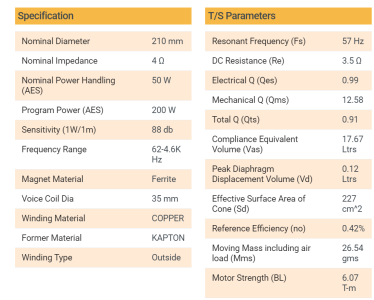
Problem is most of Sweton drivers have high Qts (very weak magnet). And they have high Fs, means a lighter than normal cone and still high Qts. Lighter cone means their Qts should have been lower actually. How does one use an 8" sub with Fs=57Hz, Qts=0.91? Probably only open baffle/dipole. Its a problematic driver for sealed use, ported is out of question
1772535738942.png

These days there are so many drivers online and they all use good looking Chinese parts and weak magnets, resulting in high Qts.
In contrast, compare with entry level Dayton 8" sub

@Sumanta, are you using the 8" in OB/dipole?
 
Last edited:
Problem is most of Sweton drivers have high Qts (very weak magnet). And they have high Fs, means a lighter than normal cone and still high Qts. Lighter cone means their Qts should have been lower actually. How does one use an 8" sub with Fs=57Hz, Qts=0.91? Probably only open baffle/dipole. Its a problematic driver for sealed use, ported is out of question
View attachment 95353

These days there are so many drivers online and they all use good looking Chinese parts and weak magnets, resulting in high Qts.
In contrast, compare with entry level Dayton 8" sub

@Sumanta, are you using the 8" in OB/dipole?
I am not understanding why high Qts will mean very weak magnet. Qts is function of Qms and Qes...so both impact a Qts.
What value is high, what is the starting point? For all these 3 Qs? There are many variables including the cabinet, so I am not understanding your first line. I am very poor in T/S, considering that can you please explain? By your logic then OBs do not need that much magnet strength or overall high Qts means very low magnet power (Bl that is isn't it?) and Qes is th ability of the driver to control its cone movement with motor power. something is not right.

Anyway, I have used 6" woofer in TLs and they are working fine. Have you used Sweton or just refering to data and infering usual notion from paper?
I am going to use the 8" woofer in a hybrid OB/TL, something similar smaller to my earlier design using an Ahuja wide bander. I am not working on paper/test/graph method. I go by ears alone. and am happy with Sweton.
 
I guess the question might be how faithful a copy the OP seeks. If it's just some TMM topology and scratch-design, that's different. My quick scan of the "Home" catalog ("Pro" catalog doesn't have TS param at all ???) has me concur that they're all much higher Q than will "drop in" as subs for the original Daytons (which seem available already imported (?) at diyaudiocart). That's not the corner to cut, or at least not the way to cut it IMO if you are trying to copy the design. Speakers are an enormous amount of work and best chances for success are staying faithful to proven design. Otherwise, be ready to do more work. Nothing says you can't make some other speaker, but as Q grows, box size grows until a point where only OB/IB (or at least resistive / aperiodic loadings) can become flatter in response. For rough estimates of compatibility to what you're copying, you wish to find close values for Qts, Fs, and Vas. There really isn't a Sweton I'm seeing so far (but I really know Nothing about them and have no experience using them).
 

Attachments

I am not understanding why high Qts will mean very weak magnet. Qts is function of Qms and Qes...so both impact a Qts.
What value is high, what is the starting point? For all these 3 Qs? There are many variables including the cabinet, so I am not understanding your first line. I am very poor in T/S, considering that can you please explain? By your logic then OBs do not need that much magnet strength or overall high Qts means very low magnet power (Bl that is isn't it?) and Qes is th ability of the driver to control its cone movement with motor power. something is not right.

Anyway, I have used 6" woofer in TLs and they are working fine. Have you used Sweton or just refering to data and infering usual notion from paper?
I am going to use the 8" woofer in a hybrid OB/TL, something similar smaller to my earlier design using an Ahuja wide bander. I am not working on paper/test/graph method. I go by ears alone. and am happy with Sweton.
Qe is nothing but motor strength integration by the coil. The higher the magnetic strength the lower the Qe and the better the motor generally. Qms comes from mechanical damping of surround/spider etc, lets ignore for this discussion.
There are many variables, yes, true, but starting with a low BL, high Qts, high Fs driver is not a recipe for success.

Do OBs need a weaker magnet? Yes, compared to other alignments, pls read elsewhere. Horns, need very strong motor hence very low Qe/Qts (0.2-0.35), then comes ported(0.35-0.5), then comes sealed (0.4-0.7) and then comes OB/dipole(0.7 and higher). Just compare a few of each of these popular designs, the relation to Qts will be evident and is not by chance. Since you are into OB/dipoles, I will try to explain the high Qts/Weak magnet/OB connection, the dipole loss of OB needs to be compensated somehow, depending on baffle and driver size, of course, so generally what designers do is that they choose a weaker magnet (high Qts) which damps the resonance of the driver less than a stronger motor and thus lets the resonance provide a gain that compensates the roll off, atleast thats what the intent is. Thats why they choose Qts of 0.7 or so. Of course, nobody wants to call the driver, one with a weak magnet, but technically thats the case. Most of the local drivers have high Qts, its a sign of using cheap magnets to cut costs, which is why some DIYers import drivers. All magnets whether its Y30 or Y35, look same, so magnet size also does not tell the Qts. I have seen big magnets with poor Qts, means they are big for looks/marketing only.

Objective data comes first, and subjective follows. If we use a driver with a peak or dip at a particular frequency, the ear wont catch it, so subjective listening is not the starting point, its the end point. Both matter, but sequence matters.

When I use a driver, I measure it first. That way I know what I am dealing with.
You have used Sweton and are happy, its perfectly fine with me. I am just giving my opinion to OP.
I haven't used Sweton and dont plan to use them due to the poor technical parameters, when the parameters are considered, they are not cheap at all. If they improve the parameters, I will definitely try them.

And, I dont go by ears, coz when we listen to music there are no musicians playing, no singer singing, its just a few devices coming together and making us believe via clever technology, the audio that we have come to accept is coming from some equations inside a DSP or a media player or a TV or a mobile phone. The HD/4K video that we see also comes from some equations. The goal of music is to fool the ears and video is to fool the eyes. Probably, nobody ever put it this way before.

To the OP, its 2026, DSP is a boon, there io so much that DSPs can do with an active setup the drivers are not critical and things are much more viable even in India, you may be able to EQ a not so perfect driver, within limits, of course. I would definitely take such a route.
DSP Amplifiers like TSA7800D are available for a 2.5 or 3 way
 
Plan:
I'm planning to create a TMM tower speaker with a height of around 35-42 inches and a width of 7-8 inches, inspired by Paul Carmody's Classix 2.5 design. It will feature a 2.5-way configuration, where one woofer will be equipped with an inductor to focus on slightly lower frequencies compared to the other woofer.

Goal:
My aim is to construct this speaker on a budget using drivers that are widely available in India. I initially considered using drivers from Doogesound, although their limited edition drivers are currently out of stock. I haven’t had the chance to try Sweton speakers yet, so I’m a bit unsure about them. I’d really appreciate hearing from anyone who has experience with them!

Suggestions Needed:
I would appreciate suggestions for selecting drivers and determining the appropriate cabinet size. Any guidance or plans you can provide would be extremely helpful. I am open to modifying my approach based on your recommendations.

Previous Experience:
I have built two speakers so far: one featuring a full-range driver from Markaudio and another that is a two-way design using a Chinese driver. I am still learning and D
Do you have Equipment's to Measure Frequency response and Impedance ?
 
Well, maybe this is your cue. You have 2 speakers behind you and are working on a third. Seems you might have a potential hobby/avocation if this stuff is fun. You could start with REW and search-up convenient impedance jig plans (basically a resistor at the simplest, with an amp and a PC).
that can get you driver parameters so you can dumpster-dive for drivers and still characterize box designs confidently. There are baby steps and there are bigger jumps to all pieces of the DIY gear. Most of us that I've ever known have started exactly where you are.

OTOH, if that doesn't fit, having confidence in manufacturer specifications has value. That's another reason to pay (some include data/curves as well, such as the Daytons).
 
I guess the question might be how faithful a copy the OP seeks. If it's just some TMM topology and scratch-design, that's different. My quick scan of the "Home" catalog ("Pro" catalog doesn't have TS param at all ???) has me concur that they're all much higher Q than will "drop in" as subs for the original Daytons (which seem available already imported (?) at diyaudiocart). That's not the corner to cut, or at least not the way to cut it IMO if you are trying to copy the design. Speakers are an enormous amount of work and best chances for success are staying faithful to proven design. Otherwise, be ready to do more work. Nothing says you can't make some other speaker, but as Q grows, box size grows until a point where only OB/IB (or at least resistive / aperiodic loadings) can become flatter in response. For rough estimates of compatibility to what you're copying, you wish to find close values for Qts, Fs, and Vas. There really isn't a Sweton I'm seeing so far (but I really know Nothing about them and have no experience using them).
Dear grindstone
I'm not entirely sure about working exclusively with Sweton drivers. I'm exploring budget-friendly options that are widely available in India, whether it's DogeSound, Sweton, or something else—I haven't decided yet. My goal is to create a TMM topology with a scratch-built design. While I know I can't perfectly replicate Paul Carmody's Classix 2.5, I'm aiming for clean sound quality rather than high loudness, as it will only be used in one room. If I can't find a suitable option, I'll definitely opt for a proven design instead.
 
Well, maybe this is your cue. You have 2 speakers behind you and are working on a third. Seems you might have a potential hobby/avocation if this stuff is fun. You could start with REW and search-up convenient impedance jig plans (basically a resistor at the simplest, with an amp and a PC).
that can get you driver parameters so you can dumpster-dive for drivers and still characterize box designs confidently. There are baby steps and there are bigger jumps to all pieces of the DIY gear. Most of us that I've ever known have started exactly where you are.

OTOH, if that doesn't fit, having confidence in manufacturer specifications has value. That's another reason to pay (some include data/curves as well, such as the Daytons).

Sure thing! Actually the 4th, I’m also working on the Overnight Sensation, following a proven design. Thanks so much for your suggestion—I’ll definitely keep it in mind as I continue learning and practicing.

I was just browsing through both the Dogesound and Sweton websites for 5.5"-6" drivers.

And I belive both driver has
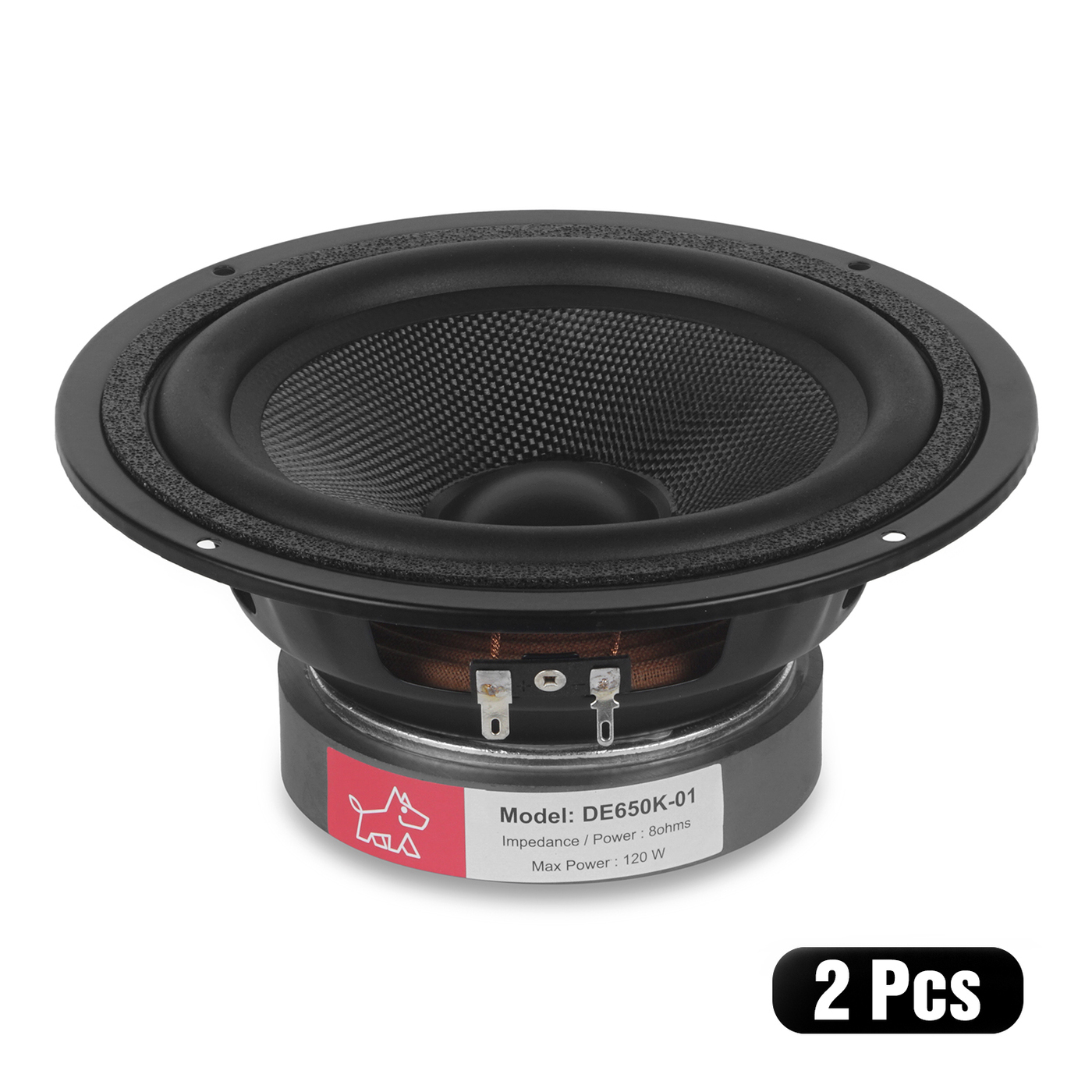
  • Very high Qts = 0.935 (DE650K-01)
  • High Qes = 1.116 (DE650K-01)
  • Fs = 57.67 Hz (DE650K-01)
  • Vas = 15.2 L (DE650K-01)
  • High Qts = 0.935 (DE650K-01)

  • High Fs = 68 Hz (SBS-1)
  • Qts = 0.72 (SBS-1)
  • Small Vas = 8.48 L (SBS-1)
  • Low Vd = 0.07 L (SBS-1)
  • Le = 0.64 mH (SBS-1)
  • EBP = 82 (SBS-1)
  • Neither driver has low Fs (<50 Hz) or large Vd
It seems like neither of them is functional for my project, right? My question is, if both drivers are so poorly designed, who actually buys them and for what purpose are they used?
 
Wharfedale Linton Heritage Speakers in Walnut finish at a Special Offer Price. BUY now before the price increase.
Back
Top