Horns for Compression Drivers in Bangalore

biyer

Active Member
Joined
Jan 15, 2009
Messages
159
Points
28
Location
Pune
Talk more about what you want, will you? The intent of the device matters a great deal and I don't know where you are well-enough to give any sort of decent answer. There are off-shelf horns all over the place, but if you, for example, want to do constant-directivity horns and directivity-match patterns at crossover, well, that's a whole other thing from just grabbing any old expo horn and designing for say 15 deg off-axis, etc. If you can't measure but can get your hands on an Eminence APT 150S 100° × 50° horn, Vance has a set of curves at aX.

Two other quick thoughts at first.
1) To get levels matched, there's one spot where you're going to need to pad 23dB...that's a whole lot and sort of defeats the purpose of the compression driver (unless it's purely to choose for horn usage). XO's for ewaves and the like are pretty easy to build-in the padding as part of the EQ/filter when one keeps attenuation say 10dB or thereabouts. FWIW.
2) 22L sealed with those starts a shallow roll really high and, that's fine if there are subs or some other LF support. If standalone, most of those types of boxes are designed with a hump at the bottom to make them more appealing / balanced. If you go 22L closed box standalone, it will be pretty "dry" (too much for my tastes).

 
@biyer , you are looking for a horn which means to me that you want constant directivity. Econowave waveguides are easily available in pro audio market. The choice of your drivers is sub optimal. In home use, the compression driver will go quite low in frequency therefore should be matched to a bigger midbass. 10" is easily possible with that compression driver, probably 12" will work too.
Also, a passive crossover will need humongous effort and DIY really pays itself when DSP is used for such a project. DSP amplifiers are locally available now. There are plethora of options now
 
@biyer , you are looking for a horn which means to me that you want constant directivity. Econowave waveguides are easily available in pro audio market. The choice of your drivers is sub optimal. In home use, the compression driver will go quite low in frequency therefore should be matched to a bigger midbass. 10" is easily possible with that compression driver, probably 12" will work too.
Also, a passive crossover will need humongous effort and DIY really pays itself when DSP is used for such a project. DSP amplifiers are locally available now. There are plethora of options now
Talk more about what you want, will you? The intent of the device matters a great deal and I don't know where you are well-enough to give any sort of decent answer. There are off-shelf horns all over the place, but if you, for example, want to do constant-directivity horns and directivity-match patterns at crossover, well, that's a whole other thing from just grabbing any old expo horn and designing for say 15 deg off-axis, etc. If you can't measure but can get your hands on an Eminence APT 150S 100° × 50° horn, Vance has a set of curves at aX.

Two other quick thoughts at first.
1) To get levels matched, there's one spot where you're going to need to pad 23dB...that's a whole lot and sort of defeats the purpose of the compression driver (unless it's purely to choose for horn usage). XO's for ewaves and the like are pretty easy to build-in the padding as part of the EQ/filter when one keeps attenuation say 10dB or thereabouts. FWIW.
2) 22L sealed with those starts a shallow roll really high and, that's fine if there are subs or some other LF support. If standalone, most of those types of boxes are designed with a hump at the bottom to make them more appealing / balanced. If you go 22L closed box standalone, it will be pretty "dry" (too much for my tastes).

Looking at constant directivity as the main motivator.

I do have the dayton imm-6. The crossover will be designed only using in box measurements.

In a 22l sealed box the sds-160 gives an F3 of around 60hz, below that will be supported by subs. Separating the boxes for HF LF for ease of experimentation.

L-pad can be constructed. Agreed the 20db approx level difference is big but it's not somthing that can't be done using high watt parallel resistors.

@diyaudio : Dont think it's an issue. One can always cross higher.

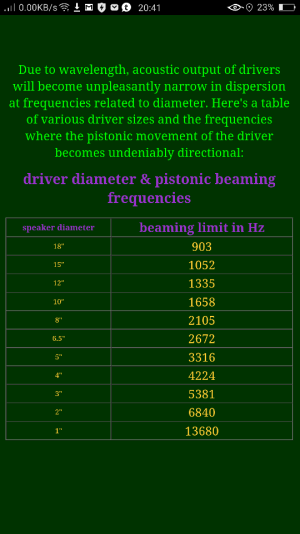
A larger woofer will need a CD which can go lower due to beaming which reduces it's usable high frequencies.

Can you tell me more of the dsp options other than mi idsp


1772678322064.png
 
Last edited:
@diyaudio : Dont think it's an issue. One can always cross higher.

A larger woofer will need a CD which can go lower due to beaming which reduces it's usable high frequencies.

Can you tell me more of the dsp options other than mi idsp

Beaming is a bad thing in normal tweeter/woofer designs. Since the tweeter is omni (or 180 degrees front only on baffle) designers want lower and lower xover so that the woofer does not beam, they want the woofer also to be omni (or 180 degrees front only on baffle).

Beaming is a good word in constant directivity designs. A waveguide beams, thats the intention, how else does one get constant directivity? Its a constant beam that we want. For example, what is a 90x50 waveguide? Its the -6dB angle of horizontal and vertical beams.

A woofer too beams and at whichever frequency it beams, it MUST be crossed to tweeter. You see the woofer/waveguide size determines the crossover frequency. That is fixed by design, then one needs to choose drivers that comfortably work till that crossover.
One cannot choose arbitrary size of woofer and waveguide and xover frequency, if one does then the constant directivity will be lost.

For this reason, constant directivity designs use bigger and bigger midbass and SAME size tweeter, the bigger driver is not for bass but to get pattern loss frequency lower and lower. A 12" will have pattern loss ie lose pattern control/beam control by 1Khz, 10" by 1200Hz and 8" by 1400Hz approx, below all these frequencies there is no beam and hence sound goes backwards as well as front which is what we are trying to avoid in the first place.
Look at TSA7800D DSP amp
 
+1. The patterns match where they match. I'd do a bigger driver if at all possible, as well. The difference between 80-something dB and 90-something dB is dynamics. Bigger driver can bring higher sensitivity, but, importantly, the larger driver can loaf (and displacement is directly proportional to distortion). A 12 moving say 0.6mm instead of the 2.2+ mm the the 6.5 driver will move will play cleaner all the time (not to mention better dynamics from sensitivity). FWIW.

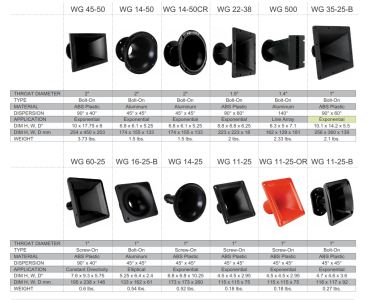
The (now discontinued) PRV WG35-25-B-1 in the link looks (?) to be a clone of the old QSC but it's expo not CD.

prv_cat_scr.png

It's dirt-cheap right now, where it can be found. The original QSCs, however, were constant directivity and were a good waveguide. Being bolt-on isn't a help in this scenario. All the little 1-inch cheap horns are screw-on. The only 1" bolt-on that seems readily available is the SB 280 which is about 11" square.

Really, if you're sold-on/already own the DFM and want to do it right, see if Marcel can modify you a TwinRay 25-12-266 to get the 21.7 deg exit angle or just go with the 520 from that thread and figure-out how to get them printed.

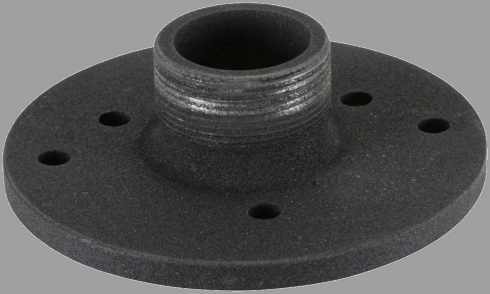
For completeness, in the other direction, there are adapters...we've all done it when we have to but...even playing games with putty, it's always worse.
adapter.png


For a 2-way, you can mess with software crossovers if you like -- just to get going. The market there vs. what I'm familiar with is so different (not to mention duties) that I hesitate to suggest anything. I know that driverack pa2 will allow you to grow to a 3rd channel and so on, but it's only cheap on the auction sites here.

After a good try, it feels like you'll need to import something to get the small bolt-on that you originally sought. Irrespective of reports regarding availability, links remain non-existent.
 
Last edited:
Join WhatsApp Channel to get HiFiMART.com Offers & Deals delivered to your smartphone!
Back
Top