

Using Studio monitors as stereo setup

This really helps is getting significant sound-stage depth when compared to other designs which sound more 2 dimensional without much depth.
this is a very critical part of a speaker design. The ability to produce bass without external reinforcement. The Dynaudio I use now does this with aplomb.
In my earlier passive set-up I had to use a subwoofer to get that extension so that I could move my bookshelves into the room for optimum positioning.
All said, larger drivers do push more air if the enclosure design allows for it to create a more natural bass.
 
Yes that's exactly what I am alluding to. I used to have 2-3 dynaudio bookshelve models in the past, and while I agree they do put out decent amount of bass when compared to similar sized woofers in other models, the quality of bass produced by a 8" woofer is in a different league - at-least ime. Ultimately the larger woofer wins, both in scale and extension. Another advantage I have noticed is at-least with the mofi, I can pull the speaker out much farther into the room without having the bass collapse as in other smaller book-shelves which use the rear wall for reinforcement. This really helps is getting significant sound-stage depth when compared to other designs which sound more 2 dimensional without much depth.
Cheers,
Sid
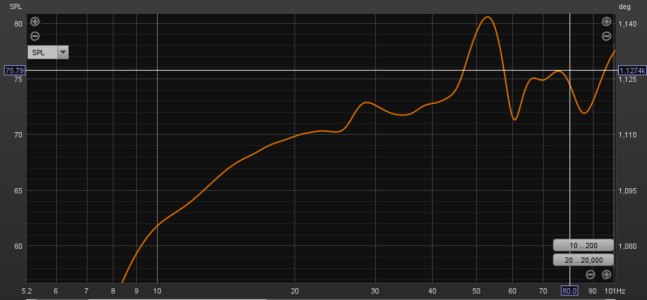
Can't disagree - there's no replacement for displacement. The lowest bass frequencies provides the foundation and adds to the soundstage and i suspect the reason why Spendor's do it so well is because they have a very linear roll off all the way down to 20hz and beyond.

Low volume notwithstanding, this is the roll off of the Spendor Classic 2/3 below 100hz - room nodes aside, notice that the speaker is only -6db down at 20hz from that of 80hz.

1766830869567.png
 
About 99% of the bookshelves that I have heard and owned mostly had a 6" woofer (1 maybe had 7"). Since I switched to a mofi sourcepoint (with a 8" coaxial driver), I will never go back to those smaller woofers again. I am hearing proper bass frequencies from a book shelf design now.
Cheers,
Sid
What about the critical higher midrange frequencies (1600-3200 Hz) from such a setup. I have found it to be somewhat lacking in most of the systems. (Of course my experience with 8" drivers has mostly been PA systems, which come with compression driver "tweeters")
 
What about the critical higher midrange frequencies (1600-3200 Hz) from such a setup. I have found it to be somewhat lacking in most of the systems. (Of course my experience with 8" drivers has mostly been PA systems, which come with compression driver "tweeters")
No issues in the all critical mid/higher ranges with the Mofi 8. They sound excellent.
Cheers,
Sid
 
What about the critical higher midrange frequencies (1600-3200 Hz) from such a setup. I have found it to be somewhat lacking in most of the systems. (Of course my experience with 8" drivers has mostly been PA systems, which come with compression driver "tweeters")
The coaxial geometry of the design is what is helping with the midrange here although the driver looks rather large to handle the frequencies just below 1.6khz ( which is the tweeter crossover point for the sourcepoint design). This wont work if the drivers were separated physically like a normal two way loudspeaker. In the sourcepoint, I think the below are happening.
  • Coaxial geometry (no driver spacing issue)
  • Cone used intentionally as a waveguide
  • Matched directivity through crossover
  • Very stiff, well-damped cone ( Breakup modes pushed well above the crossover point)
 
The coaxial geometry of the design is what is helping with the midrange here although the driver looks rather large to handle the frequencies just below 1.6khz ( which is the tweeter crossover point for the sourcepoint design). This wont work if the drivers were separated physically like a normal two way loudspeaker. In the sourcepoint, I think the below are happening.
  • Coaxial geometry (no driver spacing issue)
  • Cone used intentionally as a waveguide
  • Matched directivity through crossover
  • Very stiff, well-damped cone ( Breakup modes pushed well above the crossover point)
But there should be typical problems related to coaxial drivers in this case also or Mofi has come up with something to take care of the IMD which is associated with cone vibration (basically waveguide vibration in coaxial speakers)?
 
Wharfedale Linton Heritage Speakers in Red Mahogany finish at a Special Offer Price. BUY now before the price increase.
Back
Top