Yes, I wanted to keep things simple; that's why I didn't specify it. We actually need a resistive dummy load of 8, 4, or 2 ohms for accurate testing.
In the real world, we should trust our ears, and basic knowledge suffices. Delving deeper may complicate matters, but while it can be beneficial, it will also make things much more complex.
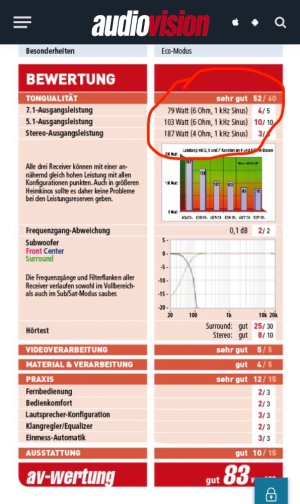
Your AVR240 delivers 60-65 W RMS in stereo mode. Now, let's discuss speakers. What type of speaker are you using? We need to consider speaker impedance, but it's also important to discuss speaker sensitivity at the same time; only then does it make sense.
For instance, if you have 8 ohm-89 dB speakers connected to your AVR and you set the listening volume to 25, you'll experience room-filling sound. Conversely, if you switch to 2 ohm speakers, they will require more power to achieve the same volume. This means you would need to raise the volume to 50, which forces the amplifier to provide more power to the speakers, potentially leading to stress on the amplifier, heating issues, clipping, and so on.
Now, let's consider another scenario.
If you are using 8-ohm, 100 dB speakers with your AVR and your listening volume is set to 10, you will still get room-filling audio, but you'll only need half the power to make that speaker louder.
However, if you use a 65W AVR with 100dB speakers, instead of music, you might hear hissing or white noise (which is a topic for another discussion).
Cheers.
vishnu




 do I pick up from the manual?

 and not in electronics and electrical engineering