It needs a crossover so low that the tweeter cant handle itI really don't understand lobing but understand it can be controlled by having a low crossover and sandwiching the tweeter as close to the midranges as possible. It also depends on careful driver matching to get the best result.

You are using an out of date browser. It may not display this or other websites correctly.
You should upgrade or use an alternative browser.
You should upgrade or use an alternative browser.
Speaker Designers Needed.
- Thread starter chander
- Start date

There is no relation between ultra expensive speakers and MTM. MTM looks good and ultra expensive speakers cater to a different public, the speakers are designed for aesthetics first and acoustics take aback seat. There is a lot of marketing hype and snake oil theories. There is no scientific data to support the high price. There will always be a market for it as the buyer belongs to a niche group.Just pointing out that most ultra expensive speakers seem to be designed symetrically with a WMTMW layout, or a MTM sandwich somewhere in the design.
Must be a reason for it.
I am not against MTM, I may be building next project with MTM myself as my primary listening position is sitting at one place on sofa.
I just wanted to tell the problems with it. Coax solve these problems and OP is already inclined to use it.
Do these ultra expensive speakers give distortion graphs, polar charts, power compression at full power etc? No they dont.
One of the reasons I like DIY is because I know with DIY we can trump these so called ultra expensive speakers which can be very rewarding in itself

grindstone
Well-Known Member
Yeah, as they will be active, all that's really necessary to aid the OP is to specifically identify the two drivers. Then, speaker designs can fall out of the Aether. If you know where he might source reputable coaxes from trustworthy manufacturers, it may be helpful for you to choose an example 6 or 8.
BTW, MTM were popular in the 60's for a bit but it's only after Joe d' Appolito figured our some filtering maybe 30 years ago that the vertical polars really got "fixed". Then, of course, everyone had to build them for a spell, like any other speaker topology fad.
Re the "lobing" in this vernacular: Drivers narrow their dispersion as frequency increases (aka their beamwidth narrows or they "beam"). At low freqs (long wavelength relative to source size), radiation is hemispherical blob. Increasing frequency, the blob narrows to a sort of teardrop. Increasing frequency further, it begins to form side "lobes" (sic). Reality is revolved 3-D for pistonic sources.
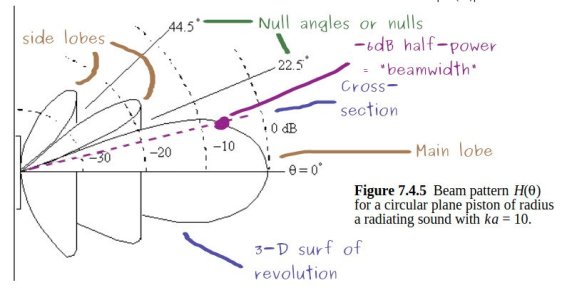
That's one part of it. Now, add a second source. The distance from each to a given receiving positon will be different. What happens is frequency-dependent constructive and destructive interference. Like throwing two rocks in the water--some spots have wave peaks, some spots have troughs. It you keep the two radiation sources within a distance of say 1/4 wavelength at crossover, they combine as a single source to make a single forward lobe. Fore- or aft- positioning of each relative to the other will then begin to "tilt" or rotate their main lobe (and pattern) when viewing the vertical plane from the side.
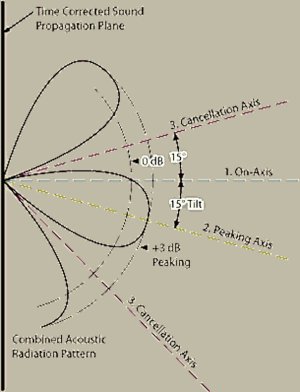
Filters mess with phase and can thus move/rotate the radiation pattern as well. By inspection, then, the choice for axis of measurement relative to forward lobe axis matters. This can show as "polar problem". Just jockey things so that you can sit in the big fat forward lobe, and all is well, basically. Aim the vertical nulls at that ceiling reflection and floor bounce and your spectral balance is more forward lobe and less reflection, etc. Of course nothing is quite that simple when considering breakup modes and non-ideal drivers and no speakers are perfect. The OP need not think about any of this and in a way, the coax choice can make everything easier.
BTW, MTM were popular in the 60's for a bit but it's only after Joe d' Appolito figured our some filtering maybe 30 years ago that the vertical polars really got "fixed". Then, of course, everyone had to build them for a spell, like any other speaker topology fad.
Re the "lobing" in this vernacular: Drivers narrow their dispersion as frequency increases (aka their beamwidth narrows or they "beam"). At low freqs (long wavelength relative to source size), radiation is hemispherical blob. Increasing frequency, the blob narrows to a sort of teardrop. Increasing frequency further, it begins to form side "lobes" (sic). Reality is revolved 3-D for pistonic sources.
That's one part of it. Now, add a second source. The distance from each to a given receiving positon will be different. What happens is frequency-dependent constructive and destructive interference. Like throwing two rocks in the water--some spots have wave peaks, some spots have troughs. It you keep the two radiation sources within a distance of say 1/4 wavelength at crossover, they combine as a single source to make a single forward lobe. Fore- or aft- positioning of each relative to the other will then begin to "tilt" or rotate their main lobe (and pattern) when viewing the vertical plane from the side.
Filters mess with phase and can thus move/rotate the radiation pattern as well. By inspection, then, the choice for axis of measurement relative to forward lobe axis matters. This can show as "polar problem". Just jockey things so that you can sit in the big fat forward lobe, and all is well, basically. Aim the vertical nulls at that ceiling reflection and floor bounce and your spectral balance is more forward lobe and less reflection, etc. Of course nothing is quite that simple when considering breakup modes and non-ideal drivers and no speakers are perfect. The OP need not think about any of this and in a way, the coax choice can make everything easier.
square_wave
Well-Known Member
I certainly think the OP's problem of making his first loudspeaker is a much bigger problem than the typical "lobbing problem in the vertical axis" that MTMs create. There are many famous MTM designs that are designed to play to the strengths of MTMs and come with workarounds in the designs to reduce the negatives. I have heard some that sound excellent as long as you stay in the sweetspot area. For critical listeners who will stay in the sweet spot, MTMs are still a very valid design with great advantages.
@ the OP, if you are planning to design your own crossover and cabinet designs from scratch, it is going to be a steep learning curve. And it is quite iterative too with lot of wastage of time and material. Best is to build a kit that comes with a tested and approved crossover. Or even talk to some experienced builders on the forum and get their help with the design.
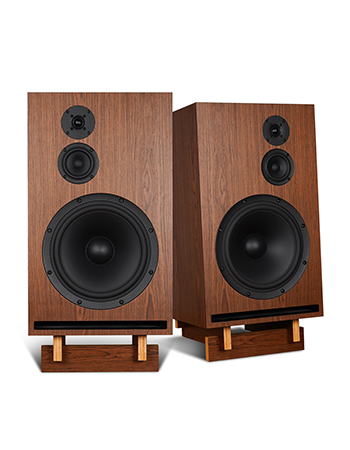
Why not this ? Available in the country. Very similar to the revival audio speaker in your picture. Goes down to 36 hz.

 audiofy.in
 sbacoustics.com
If you make a speaker using a well designed coaxial driver for the benefits of improved timing and phase coherency, then it is best made without another driver in the design. Most of time, if done by people with less experience, the benefits that you gain in terms of the aforementioned parameters will get diminished due to the lack of precise integration ( mechanical as well as overall engineering ). Food for thought!
@ the OP, if you are planning to design your own crossover and cabinet designs from scratch, it is going to be a steep learning curve. And it is quite iterative too with lot of wastage of time and material. Best is to build a kit that comes with a tested and approved crossover. Or even talk to some experienced builders on the forum and get their help with the design.
Why not this ? Available in the country. Very similar to the revival audio speaker in your picture. Goes down to 36 hz.
SB Acoustics Gema 3-way Speaker - Pair
SB Acoustics Gema is a large 3-way speaker paying homage to the classic speaker of the 1970’s. Generous enclosure proportions fitted with large bass drivers were the bee’s knees at the time. And for good reason! The Gema is our take on a retro-styled speaker, and the much loved 12″ SB34NRXL75-8...
audiofy.in
Gema - Sbacoustics
Gema is a large 3-way speaker paying homage to the classic speaker of the 1970's. Generous enclosure proportions fitted with large bass drivers were the bee's knees at the time. And for good reason! The Gema is our take on a retro-styled speaker, and the much loved 12″ SB34NRXL75-8 lays the...
sbacoustics.com
If you make a speaker using a well designed coaxial driver for the benefits of improved timing and phase coherency, then it is best made without another driver in the design. Most of time, if done by people with less experience, the benefits that you gain in terms of the aforementioned parameters will get diminished due to the lack of precise integration ( mechanical as well as overall engineering ). Food for thought!
Last edited:
square_wave
Well-Known Member
Adding to the earlier post, you need a really good coaxial driver to circumvent some of the problems they themselves present.
In a coaxial driver:
That can cause:
So, all approaches have their pros and cons.
In a coaxial driver:
- The tweeter radiates through the center of the mid/woofer
- The woofer cone is physically moving (forward/back) at low and mid frequencies
- That cone is also the acoustic boundary shaping the tweeter’s output
That can cause:
- Amplitude modulation (AM) of the tweeter
- Phase modulation (FM) of the tweeter
- Intermodulation distortion (IMD)
- Subtle time-varying directivity
So, all approaches have their pros and cons.
I still remember the sound from my cousins Gale 401's which were probably one of the earliest psedo-MTMs built in the 70's and they were one one the most musical speakers I have heard yet with great imaging and a wide soundstage even sitting outside the 'sweet' spot.There are many famous MTM designs that are designed to play to the strengths of MTMs and come with workarounds in the designs to reduce the negatives. I have heard some that sound excellent as long as you stay in the sweetspot area. For critical listeners who will stay in the sweet spot, MTMs are still a very valid design with great advantages.
square_wave
Well-Known Member
Nice. The gale 401 will not produce the lobing problem because it is a 3 way system with a dedicated midrange for mids. Crucially, ONE driver producing all of the midrange as compared to 2 drivers producing the mids in an MTM. The other 2 drivers are just woofers.I still remember the sound from my cousins Gale 401's which were probably one of the earliest psedo-MTMs built in the 70's and they were one one the most musical speakers I have heard yet with great imaging and a wide soundstage even sitting outside the 'sweet' spot.
MTM lobing occurs because:
- Two identical mid/woofers
- Play the same frequencies
- From different vertical positions
So :
- Left–right movement: generally fine
- Up–down movement: where lobing and nulls occur
Thanks, now I understand the science behind lobing.MTM lobing occurs because:
Their outputs interfere -> creating vertical peaks and nulls near the crossover. This happens mostly in the vertical axis. If you sit exactly at the tweeter height and don’t move your head, you will mostly stay inside the main vertical lobe, and the speaker can sound excellent.
- Two identical mid/woofers
- Play the same frequencies
- From different vertical positions
So :
- Left–right movement: generally fine
- Up–down movement: where lobing and nulls occur
Don't want to sidetrack this thread but any idea how tekton get away with their ring array around a tweeter ?
HifiNewbie
New Member
I like MTM designs. You get more drivers contributing to the same SPL, so cone excursion reduces by half, distortion reduces by half, and power handling gets doubled. Of course, considering it is a 2 or 3 way MTM or WMTMW and not one of those 2.5 ways MTM, which are also quite common.
Vertical lobing is not an issue as long as we have the tweeter at ear level, speakers placed vertically, and not horizontally like in a HT center channel speaker.
Vertical lobing is not an issue as long as we have the tweeter at ear level, speakers placed vertically, and not horizontally like in a HT center channel speaker.
rwnano
Well-Known Member
OP - please also consider simpler crossover designs...
Some designers swear by a single tweeter and midwoofer design..simpler crossover less work for the amplifier. Better sound...more "musical".
Also consider first order crossover
Also think about series crossover rather than parallel...
And you should visit diyaudio forums
Some designers swear by a single tweeter and midwoofer design..simpler crossover less work for the amplifier. Better sound...more "musical".
Also consider first order crossover
Also think about series crossover rather than parallel...
And you should visit diyaudio forums
Every speaker is a compromise, there is nothing called a best speaker.Adding to the earlier post, you need a really good coaxial driver to circumvent some of the problems they themselves present.
In a coaxial driver:
So, in theory, the tweeter is radiating through a moving waveguide.
- The tweeter radiates through the center of the mid/woofer
- The woofer cone is physically moving (forward/back) at low and mid frequencies
- That cone is also the acoustic boundary shaping the tweeter’s output
That can cause:
- Amplitude modulation (AM) of the tweeter
- Phase modulation (FM) of the tweeter
- Intermodulation distortion (IMD)
- Subtle time-varying directivity
Co-ax is a good compromise. With a 15" driver there is hardly any movement to cause sufficient audible artifacts, these are exaggerated.
Perry Marshall has hit the bulls eye with his designs. He sets the bar much higher than typical run of the mill kit.
Why not this ? Available in the country. Very similar to the revival audio speaker in your picture. Goes down to 36 hz.
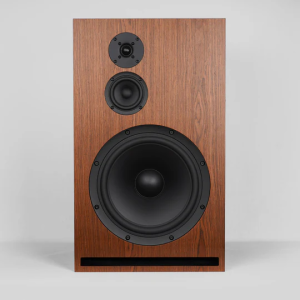
1.3L and not even a waveguide for constant directivity.
What you are saying is true of passive crossover not with DSP.@ the OP, if you are planning to design your own crossover and cabinet designs from scratch, it is going to be a steep learning curve. And it is quite iterative too with lot of wastage of time and material. Best is to build a kit that comes with a tested and approved crossover. Or even talk to some experienced builders on the forum and get their help with the design.
The OP is using DSP amps, its not difficult, he can take incremental baby steps and converge to a good design. He can delete a crossover and create a new one with a few button clicks. Peaks and dips, no problem there are several filters at disposal to correct.
Later on when he is confident, he can even turn the system into perfect linear phase as his DSPs support FIR filters too
Last edited:
I absolutely agree 100% with this statement of yoursEvery speaker is a compromise, there is nothing called a best speaker.

square_wave
Well-Known Member
I actually like coaxial designs. I run a Fyne Audio speaker. I bought the "coaxial" into the main conversation to convey the fact that no design is perfect. Almost 50 % of my listening is off axis so the design really helps.Every speaker is a compromise, there is nothing called a best speaker.
Co-ax is a good compromise. With a 15" driver there is hardly any movement to cause sufficient audible artifacts, these are exaggerated.
Perry Marshall has hit the bulls eye with his designs. He sets the bar much higher than typical run of the mill kit.
square_wave
Well-Known Member
Sorry, I did not know he is going fully active with DSP. If that is indeed the case, it is a different story.What you are saying is true of passive crossover not with DSP.
The OP is using DSP amps, its not difficult, he can take incremental baby steps and converge to a good design. He can delete a crossover and create a new one with a few button clicks. Peaks and dips, no problem there are several filters at disposal to correct.
Later on when he is confident, he can even turn the system into perfect linear phase as his DSPs support FIR filters too
square_wave
Well-Known Member
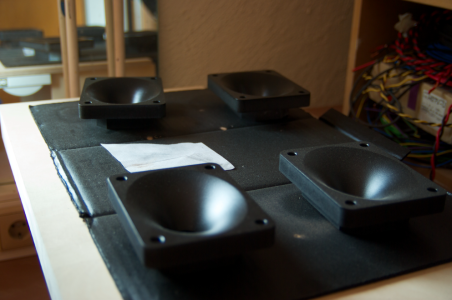
From what I have seen so far, you don't need waveguides or horns for "all" great loudspeaker designs. But if controlled, predictable dispersion over a wide frequency range is an important goal for you, you need one. Some of the greatest loudspeakers ever made use no waveguides at all but rely on other strengths instead.View attachment 94457
1.3L and not even a waveguide for constant directivity.
A “great loudspeaker” is not defined by one technique. It’s defined by how well the whole system works together:
- Tonal balance
- Great directivity
- Low distortion
- Coherent integration
- Good room interaction
- Convincing imaging
- Musical engagement
- Great timing and phase coherence
Btw, I have used a blumenhofer big fun 17 loudspeaker for many years in the past that had a waveguide. I can totally understand the love for it!
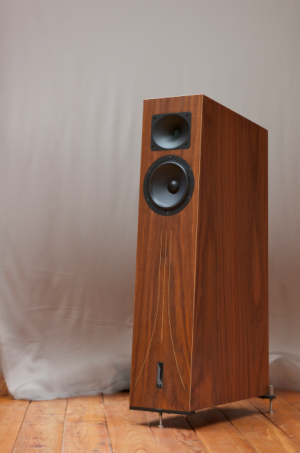
The Perry Marshall designs are awesome if he can do it.
Last edited:
Great audio folks like Floyd Tool, Earl Geddes, Perry Marshall and few others have mandated good on-axis and off-axis response, they rate it very high as this is how natural hearing is. Yes, its is my goal but that's because what I have learnt from them. Without waveguides we cant achieve this goal.From what I have seen so far, you don't need waveguides or horns for "all" great loudspeaker designs. Some of the greatest loudspeakers ever made use no waveguides at all but rely on other strengths instead.
A waveguide would benefit the bold ones above from your list. You have given more points to the need of waveguide than I didA “great loudspeaker” is not defined by one technique. It’s defined by how well the whole system works together:
- Tonal balance
- Great directivity
- Low distortion
- Coherent integration
- Good room interaction
- Convincing imaging
- Musical engagement
- Great timing and phase coherence

The newer constant directivity products like Dutch and Dutch 8C, Kai Audio KII3 with BXT, Earl Geddes's designs and Genelec designs would trump the earlier designs. Only blind A/B testing would confirm subjectively. But then there are polar charts of both the designs already available and its very clear. Times have changed.Some of the greatest loudspeakers ever made use no waveguides at all but rely on other strengths instead.
Its 2026 and I believe, passive crossovers and non waveguide designs are a thing of past especially for DIYers like us, DSP offers so much and there are plenty of amps and drivers available, no dearth of anything. If one has a budget, one can make a very nice system that commercial designs dont offer.
Last edited:
Join WhatsApp Channel to get HiFiMART.com Offers & Deals delivered to your smartphone!
Similar threads
- Replies
- 1
- Views
- 6K

- Replies
- 13
- Views
- 6K

- Replies
- 17
- Views
- 29K

- Replies
- 161
- Views
- 49K