Speaker Designers Needed.

The newer constant directivity products like Dutch and Dutch 8C, Kai Audio KII3 with BXT, Earl Geddes's designs and Genelec designs would trump the earlier designs. Only blind A/B testing would confirm subjectively. But then there are polar charts of both the designs already available and its very clear. Times have changed.
Its 2026 and I believe, passive crossovers and non waveguide designs are a thing of past especially for DIYers like us, DSP offers so much and there are plenty of amps and drivers available, no dearth of anything. If one has a budget, one can make a very nice system that commercial designs dont offer.
At the outset, let me say that I am a fan of speakers that come with waveguides or dual concentric drivers. If they dont come with one of those, then the design has to be special enough to get acceptable directivity but are still maximising the benefits of not having a waveguide.
I agree....Waveguides are a powerful tool, but they are not an absolute requirement for a great loudspeaker. They primarily address dispersion control and off-axis consistency, which is only one part of sound quality. Many world-class manufacturers deliberately choose other priorities and achieve outstanding results without waveguides at all. Companies like Vandersteen Audio focus on time- and phase-coherent designs using low-order crossovers and physical driver alignment; Wilson Audio prioritizes dynamic realism, scale, and mechanical time alignment through modular enclosures; and ATC achieves exceptional accuracy via dedicated midrange drivers, massive motors, and active control rather than radiation shaping. These speakers are globally respected precisely because they excel in tonal realism, dynamics, and musical engagement—demonstrating that waveguides are a design choice, not a prerequisite. In loudspeaker design there is no single “correct” solution, only informed tradeoffs, and history clearly shows that greatness can be achieved through multiple, equally valid paths.

I agree with you that "fully active systems" utilising an active crossover and separate outboard amplification for each driver will outperform a passive crossover type loudspeaker that is driven with just one amplifier. However that increases complexity and cost.

However, most speakers that have these amps inbuilt into the speaker chassis itself and driven by an active crossover sound great but many are easily beaten by systems that use a more traditional approach. They usually have their pros and cons. Very subjective stuff. I personally know someone who bought a costly active genelec to sell it soon and went back to a traditional system.

There are of course very high end DIY people who make custom stuff that are really awesome. But those are usually not very commercially feasible.

At the OP, sorry for diverting the topic. Many apologies if this is diverting the thread from your goal.
 
Last edited:
Yes. In 2026, there are smartly designed waveguides available for easy DIY that are significantly better than any commercial ones.. :)
So all the following and more can be easily achieved in DIY..
  1. dispersion control and off-axis consistency
  2. time- and phase-coherent designs
  3. dynamic realism and scale
  4. tonal realism, dynamics, and musical engagement
Don't believe me? ;)
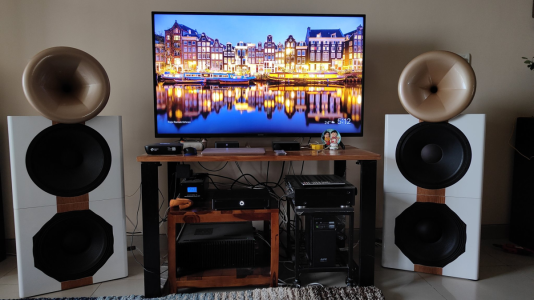
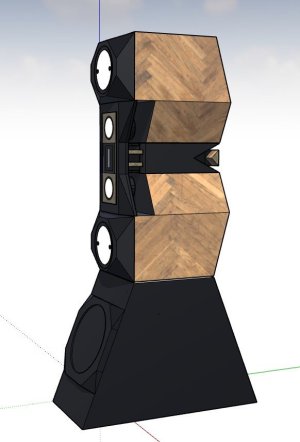
Here is a 3way system that I put together (off course with help from @sadik who built the cabinets and the horn for me).
Both midbass and sub use "small" 40litres sealed cabinets.. :D
1767531997560.png

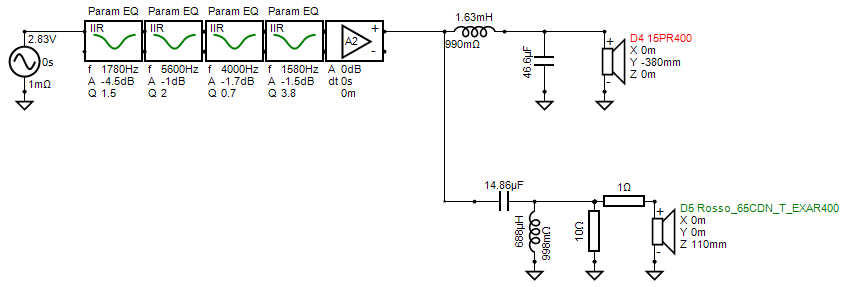
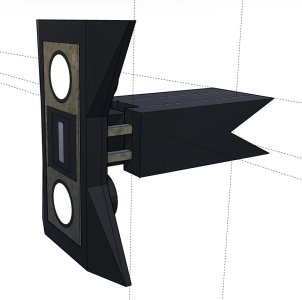
passive crossover between the midbass (Faital pro 15PR400) and the horn (EXAR 400 horn with SB Audience 65CDN-T compression driver with a custom 1.4-inch to 1-inch throat adaptor)
The crossover between midbass and horn is approximately 850Hz, passive. The crossover between the subwoofer (SB audience NERO SW800) and midbass is approximately 80Hz and is implemented using a Minidsp. Hypex NC250 amplifier drives the midbass-horn section. An O&B amp drives the subwoofer
1767532255887.png
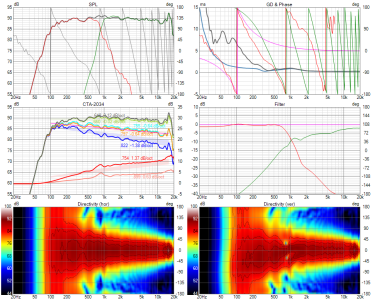
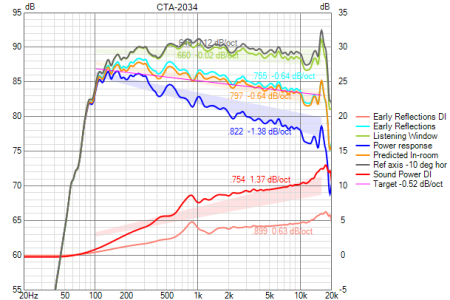
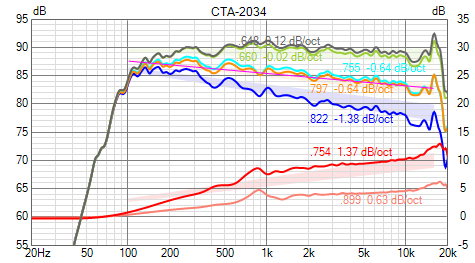
Measurements
1767532267415.png

For the sake of completeness, and for someone who wonders what it all sounds like (with all faults in the process of streaming a low-res file from Spotify, recording with a mobile phone, and putting it on YouTube), here is something


Not even sky is the limit these days.. ;)
Those manufacturers using flowery language to describe things and make it all seem achievable only via some proprietary techniques are simply lying. :P
 
@Vineethkumar01, sounds great for a mobile phone recording. First impressions are clarity and a big sound.

Don't large drivers like what you have overload the room as I don't I see any room damping.
Large driver produce constant directivity into lower frequency than smaller drivers and hence send less energy into the room hence they are better suited to small rooms. I know its counter intuitive but thats the physics of constant directivity
 
@Vineethkumar01, sounds great for a mobile phone recording. First impressions are clarity and a big sound.

Don't large drivers like what you have overload the room as I don't I see any room damping.
From what I can see in his original post, he said " Both midbass and sub use "small" 40litres sealed cabinets." I guess that is why it is working well. If you make large volume conventional speakers with such large drivers and especially ported designs, the speaker will almost certainly overload the room. I am sure it is the particular design characteristics and driver characteristics that makes it work well. @Vineethkumar01 , could you shed some light on those ?
 
From what I can see in his original post, he said " Both midbass and sub use "small" 40litres sealed cabinets." I guess that is why it is working well.
I completely missed that. That's a volume slightly smaller than 1½ CFT which is really tiny for a 15" mid driver that goes down to 850 hz
 
Regarding the big drivers overloading the room, I agree with @diyaudio. It is just a myth.
Larger drivers can potentially control directivity down to the lower midrange region and, therefore, are preferable in smaller rooms from the perspective of minimising SBIR from neighbouring boundaries, if one doesn't want to explicitly implement directivity control mechanisms similar to ones found in the Dutch and Dutch and Kii 3 speakers

That said, low bass lies in the modal region where the acoustic environment around the speaker doesn't care whether it is a small driver or a big driver. The "overload"/"boom" depends on how much and which modes are excited. As long as a mode is excited, it will contribute to the sound that one hears at the listening position. Directivity also plays some role even at low frequencies (Take a look here for monopole vs dipole vs cardioid radiation interaction with room modes and a comparison in that sense here: https://www.audiosciencereview.com/...ectivity-patterns-couple-to-room-modes.45518/ )

If you look at my measurements above, you can see that I have 4dB+ sound power DI above 300Hz.
That helps with me being able to afford a little less room treatment from SBIR point of view.
However, having room treatment will definitely improve atleast the flutter echo.
1767629570987.png

Rearding ported cabinets for woofers, I generally dont like it.
I feel that bass reflex is a fundamentally flawed way to get bass at SPLs needed in home settings. I liked sealed alignments a lot.
With bass reflex, it is always a juggling of different parameters. Port chuffing vs midrange leakage vs efficiency at lower frequencies vs other things. Why go to all that trouble when one can get away with sealed.

I use smaller sealed cabinets for the midbass and subwoofer just so that I can accommodate them in my room without being a visual nightmare. :)
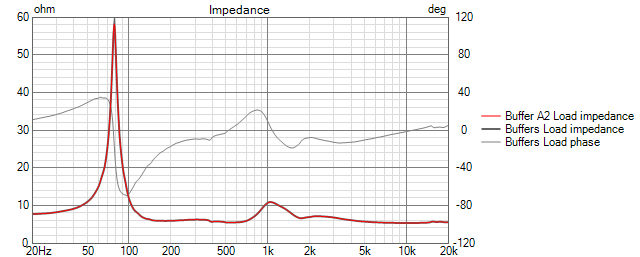
With the midbass, this also helps with a natural drop off of low frequencies around 80Hz at 12 dB/ocatve. This helps me cross it to the sub easily without additional high pass filter on the midbass. Below is an impedance plot showing the tuning frequency of the midbass and the overall impedance curve of the passive crossover based 2way top of the whole speaker
1767630116397.png

I linkwitz transform EQd the subwoofers. They give me plenty more than the bass I need at home
 

Attachments

  • 1767629555518.png
    1767629555518.png
    46.6 KB · Views: 1
Regarding the big drivers overloading the room, I agree with @diyaudio. It is just a myth.
Larger drivers can potentially control directivity down to the lower midrange region and, therefore, are preferable in smaller rooms from the perspective of minimising SBIR from neighbouring boundaries, if one doesn't want to explicitly implement directivity control mechanisms similar to ones found in the Dutch and Dutch and Kii 3 speakers

That said, low bass lies in the modal region where the acoustic environment around the speaker doesn't care whether it is a small driver or a big driver. The "overload"/"boom" depends on how much and which modes are excited. As long as a mode is excited, it will contribute to the sound that one hears at the listening position. Directivity also plays some role even at low frequencies (Take a look here for monopole vs dipole vs cardioid radiation interaction with room modes and a comparison in that sense here: https://www.audiosciencereview.com/...ectivity-patterns-couple-to-room-modes.45518/ )

If you look at my measurements above, you can see that I have 4dB+ sound power DI above 300Hz.
That helps with me being able to afford a little less room treatment from SBIR point of view.
However, having room treatment will definitely improve atleast the flutter echo.
View attachment 94511

Rearding ported cabinets for woofers, I generally dont like it.
I feel that bass reflex is a fundamentally flawed way to get bass at SPLs needed in home settings. I liked sealed alignments a lot.
With bass reflex, it is always a juggling of different parameters. Port chuffing vs midrange leakage vs efficiency at lower frequencies vs other things. Why go to all that trouble when one can get away with sealed.

I use smaller sealed cabinets for the midbass and subwoofer just so that I can accommodate them in my room without being a visual nightmare. :)
With the midbass, this also helps with a natural drop off of low frequencies around 80Hz at 12 dB/ocatve. This helps me cross it to the sub easily without additional high pass filter on the midbass. Below is an impedance plot showing the tuning frequency of the midbass and the overall impedance curve of the passive crossover based 2way top of the whole speaker
View attachment 94512

I linkwitz transform EQd the subwoofers. They give me plenty more than the bass I need at home
Totally agree with your thought process.

Larger drivers can indeed help control directivity in the lower midrange and upper bass, which can reduce SBIR effects in small rooms. However, in the true bass region the room response is dominated by modes, and driver size by itself doesn’t determine ‘overload’ — placement, output level at lower frequencies, and modal excitation do. Large drivers only become a problem in small rooms when they’re asked to produce more low-frequency energy than the room can support.

This missing link in the conversation is -> How low the large driver is allowed to play, and how the bass is managed. Irrespective of driver size. In conventional speaker designs, the larger the speaker driver and resulting enclosure volume, they are asked to play lower.
 
I really don't understand lobing but understand it can be controlled by having a low crossover and sandwiching the tweeter as close to the midranges as possible. It also depends on careful driver matching to get the best result.

Just pointing out that most ultra expensive speakers seem to be designed symetrically with a WMTMW layout, or a MTM sandwich somewhere in the design.

Must be a reason for it.
That’s a fair observation. Lobing can be confusing, but your point about low crossover points and tight driver spacing makes sense. The fact that many high-end speakers use symmetric WMTMW or MTM designs does suggest there’s a solid acoustic reason behind it, not just aesthetics.
 
The fact that many high-end speakers use symmetric WMTMW or MTM designs does suggest there’s a solid acoustic reason behind it, not just aesthetics.
The traditional speakers by commercial companies didn't care about vertical directivity at all. None published vertical directivity, it's a fact. Times have changed. Commercial speakers are sold, marketed and bought by aesthetics first and sound later. How many flat panel TVs have good speakers? They can't afford to put big drivers in TVs as it will bring down the aesthetics of the slim Tv. Sounbars have become very popular. Puny 2.5 inch full range and a 5.25 or 6 5 inch driver for subwoofer, all because aesthetically it goes well with the TV. We better not take such commercial speakers as an example as MWTWM without vertical directivity plots published. As DIYers we are trying to be ahead them, not behind them.
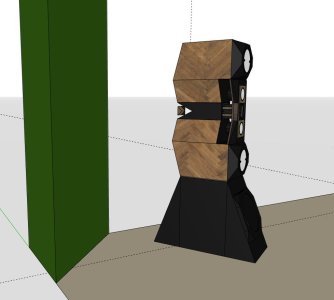
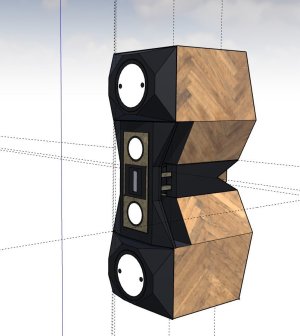
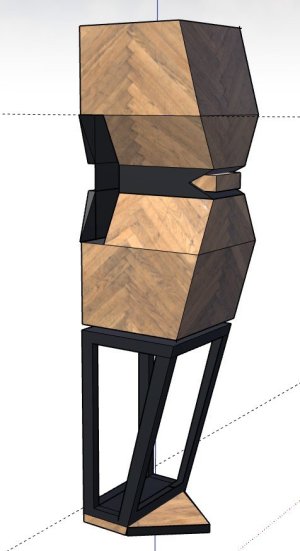
Perry Marshall's Bitches Brew speaker is a speaker we should try to clone.
 
Donno if OP has finished his vacation or not 😜! But very good DIY conversations!
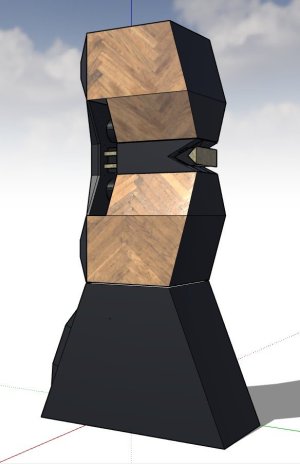
I wish I was on vacation - but I am right here. Listening to music and falling deeper into a rabbit hole.

I am also visiting this thread everyday - read something more and then go and fall into another hole.

I was hoping to stumble upon a design - a manual rather - that says - build this. But I think that won't be the case.

Regardless - the direction this thread is heading in is brilliant. Keep it coming guys.
 
What keeps it simple is knowing what you can buy locally. If you can pick a coax and a woofer, the designs will fall out of the sky and you can steer your own thread again :)
 
That’s a fair observation. Lobing can be confusing, but your point about low crossover points and tight driver spacing makes sense. The fact that many high-end speakers use symmetric WMTMW or MTM designs does suggest there’s a solid acoustic reason behind it, not just aesthetics.
Totally agree. The Living Voice R80 is a solid example of a great MTM design. I have been to numerous auditions of that loudspeaker at a local friendly dealer. Outstanding design. I have also spoken at length about the design with the designer who frequent the shop for official demo events. Keep in mind he is also the designer of the cost no object vox olympian which is a horn design. He is a great example of someone who is totally in love with both the waveguide / horn as well as the MTM concepts. Both come with their own little pros and cons.

Btw, many classical music listeners prefer non wave guide speakers because :-
  • Controlled directivity reduces room contribution
  • Hall reverberation is reproduced more explicitly, not blended
  • The orchestra sounds more “in front of you” than “around you”
  • Horns (if not perfectly designed) can affect tone. They have a tonal imprint. Avid classical listeners are super sensitive to it.
Some listeners love this.
Others feel it reduces the sense of true tone, bloom and envelopment they associate with live classical music.

Of course, waveguides come with the benefit of vertical directivity. It is good if you are not a seated listener.
 
Purchase the NEW Audiolab 6000A MkII Integrated Amplifier at a special offer price.
Back
Top